Updated August 2026 — Strength, Flavours, Format, Price, and Canadian Availability Compared
This guide comparing Zyn vs Velo is for informational purposes only and is not medical advice. Nicotine pouches are age-restricted, addictive nicotine products intended for adult use. If you don’t currently use nicotine, don’t start.
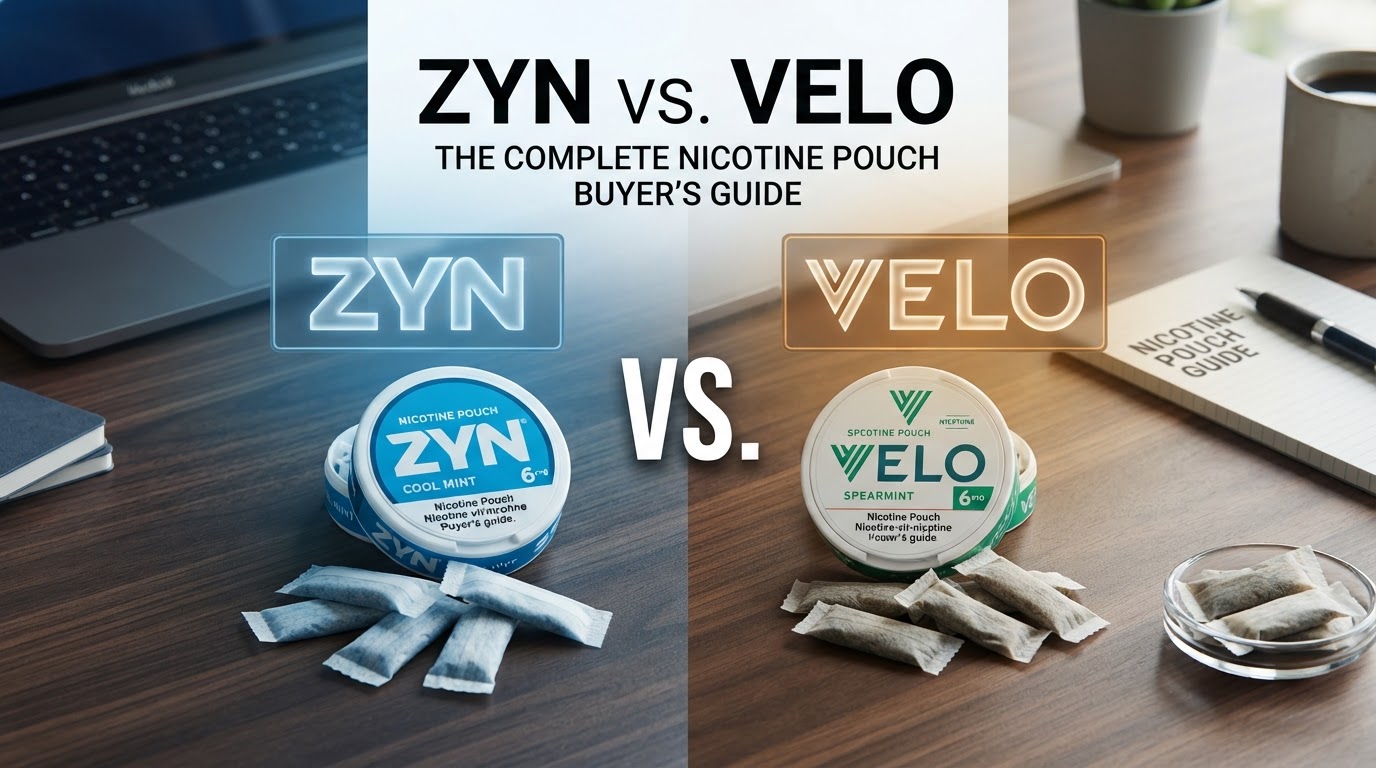
Nicotine pouches have become one of the fastest-growing categories in the smoke-free nicotine market, and two names come up in almost every conversation about them: ZYN and VELO. Both are tobacco-free, spit-free pouches that sit discreetly between the gum and lip, releasing nicotine without smoke, vapour, or combustion. Both are backed by major tobacco companies, sold in dozens of flavours and strengths internationally, and have loyal followings that will happily argue for hours about which one is better. This guide isn’t here to settle that argument. Instead, it walks through the concrete, verifiable differences between ZYN and VELO — ownership, ingredients, format, nicotine strength, flavour lineup, release speed, pricing, and, importantly for anyone shopping in Canada, current legal availability — so you can decide for yourself which fits your needs, if either is a legal option where you live.
It’s worth setting expectations at the outset: this is a comparison, not a recommendation. ZYN and VELO are different products built by different companies with different formulation philosophies, and the “better” choice genuinely depends on what an individual adult nicotine user is looking for — a slower release or a faster one, a smaller flavour menu or a wider one, a lower strength ceiling or a higher one. What follows is organized so you can weigh each factor on its own terms rather than taking anyone’s word for which brand comes out ahead overall.
What Are ZYN and VELO, Exactly?
Both ZYN and VELO fall into the same product category: oral nicotine pouches, sometimes called “nicopods” or tobacco-free snus. Unlike traditional snus, which is made from ground, moist tobacco leaf, both ZYN and VELO pouches use a plant-fibre filler infused with nicotine, flavourings, and pH-adjusting agents, with no tobacco leaf at all. The pouch itself looks and feels similar to a small tea bag. It’s placed under the upper lip, where it stays for anywhere from 20 minutes to an hour, releasing nicotine through the gum tissue rather than through inhalation.
The two brands are owned by two different, competing tobacco multinationals. ZYN is manufactured by Swedish Match, a company that has been owned by Philip Morris International since PMI’s roughly sixteen-billion-dollar acquisition in 2022. VELO is manufactured by British American Tobacco, one of PMI’s largest global competitors. In other words, ZYN and VELO aren’t just competing consumer brands — they’re the flagship nicotine pouch products of two rival tobacco giants, each investing heavily in marketing, flavour development, and international distribution to capture share of the fast-growing pouch category.
Ingredients and Pouch Construction
At the ingredient level, ZYN and VELO are more similar than different. Both use food-grade fillers, synthetic or plant-derived nicotine, flavouring agents, sweeteners, and moisture-control ingredients, and neither contains tobacco leaf. Where the two brands diverge is in pouch texture and moisture content, which has a real, noticeable effect on the user experience.
The plant-fibre base used in both products is typically a food-grade cellulose or similar bulking agent, chosen because it holds moisture and flavouring evenly while remaining comfortable against the gum for extended periods. Nicotine is added in a purified, extracted form rather than as part of raw tobacco, and both companies adjust the pH of their formulations to control how quickly that nicotine crosses into the bloodstream through the gum tissue — a more alkaline, higher-pH formulation tends to speed up nicotine absorption, which is part of why VELO’s moister, typically higher-pH pouches are often described as delivering a faster, more noticeable hit than ZYN’s drier, lower-pH format. This pH-driven difference in absorption speed is one of the more technical but genuinely important distinctions between the two brands, and it’s a big part of why a straight milligram-to-milligram comparison between ZYN and VELO products doesn’t always match the real-world experience of using them.
ZYN pouches are generally formulated to be drier than VELO’s standard lineup. A drier pouch tends to release nicotine and flavour more slowly and evenly, producing a longer, steadier sensation with less noticeable “drip” or moisture pooling under the lip. VELO pouches, particularly in the original VELO line, are formulated with more moisture, which speeds up nicotine absorption through the gum and tends to produce a faster, more pronounced initial hit that some users describe as more intense, but that also tends to fade somewhat sooner than a ZYN pouch’s steadier release. BAT’s newer VELO Plus formulation has adjusted this profile somewhat, positioning itself as a stronger, longer-lasting option within VELO’s own range.
Neither pouch stains teeth or requires spitting, which is one of the core selling points of the category over traditional dip or chewing tobacco. Both brands package their pouches in small, round plastic cans with a lid designed to also hold used pouches, keeping the experience discreet in a way that inhaled products like cigarettes or vapes simply can’t match.
Nicotine Strength: ZYN vs VELO Comparison
Nicotine strength is where shoppers most often start when comparing these two brands, and it’s also where the numbers get the most confusing, because ZYN and VELO offer different strength lineups in different countries. In markets where both brands are sold at full strength — much of the United States and the European Union, for instance — ZYN typically offers a 3mg and a 6mg option as its core lineup, with some regional and limited variants extending slightly beyond that range. VELO’s standard lineup has historically centred on 4mg and 7mg options, with the VELO Plus line pushing into stronger territory, reaching 9mg and, in some markets, higher still, alongside extra-strong specialty releases marketed toward experienced users transitioning from cigarettes or dip.
Because of the difference in pouch moisture and release speed described above, milligram numbers alone don’t tell the whole story. A VELO pouch and a ZYN pouch carrying similar nicotine content won’t necessarily feel identical — VELO’s faster-releasing, moister format tends to feel more intense in the first few minutes, while ZYN’s drier, slower-releasing format tends to feel more gradual but sustain longer. Shoppers comparing the two brands purely by milligram count on the label may be surprised that the in-mouth experience doesn’t line up exactly the way the numbers suggest.
On the whole, VELO’s global lineup tends to reach higher maximum strengths than ZYN’s, particularly with the VELO Plus range, making it the brand more likely to offer an option for very experienced nicotine users seeking the strongest available legal pouch in markets where both are sold. ZYN’s lineup, by contrast, is generally viewed as more tightly focused around low-to-moderate strengths, which some users find easier to navigate when they’re first switching from cigarettes or smokeless tobacco and want to avoid an overly intense product.
Flavour Lineups: Classic vs. Bold
Flavour is one of the most subjective parts of any nicotine pouch comparison, but the general shape of each brand’s lineup is well documented. ZYN’s flavour catalogue leans toward classic, restrained profiles: various mint and wintergreen variations, citrus, coffee, and cinnamon are recurring staples, along with milder “smooth” or unflavoured options for users who prefer minimal taste distraction. Reviewers and long-time users frequently describe ZYN’s flavour intensity as more subdued and consistent from pouch to pouch, which some see as an advantage for all-day, repeated use, and others find underwhelming if they’re looking for a stronger flavour payoff.
VELO’s flavour lineup tends to be broader and, in many markets, bolder — spearmint and wintergreen anchor the range, but VELO has also pushed further into fruit-forward and dessert-adjacent territory with options like citrus burst, black cherry, and dragon fruit or berry variants depending on the market. VELO has also been more willing to rotate in limited or region-specific flavours over time, giving its catalogue a slightly more experimental feel compared to ZYN’s more static, predictable core lineup. Neither approach is objectively better — it comes down to whether a shopper wants a smaller number of dependable, familiar flavours or a wider menu to explore.
How Long Each Pouch Lasts
Duration is another area where the two brands diverge because of their differing moisture and release profiles. ZYN pouches, with their drier format and slower nicotine release, are commonly reported to last around 30 to 45 minutes of noticeable flavour and nicotine effect, with official guidance from the brand suggesting pouches can be kept in for up to an hour. VELO’s moister, faster-releasing pouches tend to deliver their most noticeable effect earlier, often peaking within the first several minutes, with the overall experience commonly reported to taper off somewhat sooner — frequently in the 25-to-35-minute range — even though the pouch can technically be left in longer.
For shoppers who want a long, steady background experience they can leave in for an extended period, this tends to favour ZYN’s format. For shoppers who want a quick, noticeable effect and don’t mind swapping pouches more frequently throughout the day, VELO’s faster onset may be more appealing. Individual experience varies significantly based on strength selected, pouch placement, and how often the pouch is moved or adjusted, so these figures are general tendencies rather than fixed rules.
Packaging, Format, and Discreetness
Both brands sell their pouches in round, pocket-sized tins, typically holding around 15 pouches per can, with a hinged or snap lid that doubles as a disposal point for used pouches. ZYN is particularly well known for its “Mini” format — a smaller, lower-profile pouch designed to be virtually undetectable under the lip, which has become one of its signature product lines for users who want maximum discreetness in professional or social settings. VELO offers slim and mini-style formats of its own in various markets, though ZYN’s Mini format in particular has built a strong reputation specifically around minimal visibility and comfort for extended wear.
Both brands’ standard tins are similar in size and are designed to fit easily in a pocket or bag, and both are sold in multi-can packs as well as single tins in most markets where they’re legally available, which affects the per-pouch cost comparison described below.
Price Comparison
Pricing for both ZYN and VELO varies significantly by country, retailer, strength, and whether pouches are purchased individually or in multi-can packs, which makes an exact dollar-for-dollar comparison difficult to state universally. As a general pattern reported across multiple retail comparisons, VELO is frequently positioned as the slightly more budget-friendly option per pouch, particularly with bulk or multi-can pricing on the standard and Plus lines, while ZYN has tended to command a modest premium in markets where it holds the dominant market share position, a pricing pattern common for the leading brand in a fast-growing category. That said, promotional pricing, regional taxes, and retailer markups can easily shift the actual price gap between the two brands in either direction, so shoppers comparing real-world prices should check current listings from their own retailer or region rather than relying on any fixed rule of thumb.
For Canadian shoppers focused on cost specifically, it’s worth noting that price comparisons found on international retail sites and forums almost always reflect U.S. or European pricing and availability, not Canadian pricing, since neither brand is currently sold through mainstream Canadian retail at full strength.
ZYN currently holds a dominant share of the nicotine pouch category in its largest market, the United States, with market share estimates commonly cited in the range of 70 to 75 percent of U.S. pouch sales as of the mid-2020s. That dominant position reflects ZYN’s early entry into the U.S. market in 2014 and years of aggressive distribution and marketing under first Swedish Match and now Philip Morris International ownership. VELO, while a smaller player in the U.S. by comparison, holds a meaningfully larger position in various European and international markets, where British American Tobacco has pushed VELO as its flagship smoke-free nicotine brand across a wider international footprint. Understanding this ownership and market-share context helps explain some of the differences in flavour rotation and strength lineup covered above — ZYN’s more conservative approach reflects its strategy as the established market leader, while VELO’s broader and more experimental catalogue in various regions reflects its strategy as a brand actively working to close the gap.
Both companies have made nicotine pouches a central part of their long-term corporate strategy, not a side project. Philip Morris International has repeatedly pointed to ZYN and its broader smoke-free product portfolio as central to its stated goal of eventually deriving the majority of its revenue from products other than traditional cigarettes, and the scale of its investment in Swedish Match’s manufacturing capacity, including expanded production facilities in the United States, reflects that priority. British American Tobacco has taken a broadly similar position with VELO, folding it into a wider “multi-category” strategy that also includes vaping products and heated tobacco, positioning VELO as one leg of a broader smoke-free portfolio rather than a standalone product line. This corporate context matters for shoppers because it signals that both companies are likely to keep investing heavily in flavour development, strength options, and international market expansion for years to come, rather than treating either brand as a temporary or experimental product line.
Legal Status and Availability in Canada
This is the section that matters most for anyone shopping in Canada specifically, because the picture here is meaningfully different from the U.S. or European markets most ZYN-versus-VELO comparisons are written about. As of August 2026, neither standard-strength ZYN nor standard-strength VELO is authorized for legal retail sale in Canada. Health Canada regulates nicotine pouches as natural health products under nicotine replacement therapy rules, and the regulatory threshold that determines what can be sold without a prescription is strict: any pouch containing more than 4 milligrams of nicotine is classified as a prescription drug under Canadian food and drug regulations and cannot legally be sold over the counter. Because ZYN’s core lineup starts at 3mg but commonly includes 6mg options, and VELO’s core lineup includes 7mg and stronger Plus variants, most of both brands’ standard product ranges exceed Canada’s non-prescription threshold and are therefore not authorized for sale through Canadian retail channels.
The only nicotine pouch currently authorized by Health Canada for non-prescription retail sale, as of this writing, is Zonnic, manufactured by Imperial Tobacco Canada and capped at 4mg of nicotine per pouch, sold specifically as a smoking-cessation aid under pharmacist-supervised retail rules rather than as a general consumer product on open store shelves. Following public concern about youth uptake of flavoured nicotine pouches, Canadian regulators tightened Zonnic’s own retail rules in 2024, restricting flavours to mint and menthol and moving sales behind the pharmacy counter in most provinces rather than allowing open-shelf sales at gas stations and convenience stores.
There has been meaningful regulatory movement more recently that may change this picture. In January 2026, Health Canada formally amended its Prescription Drug List to explicitly recognize nicotine buccal pouches at or below 4mg as eligible for non-prescription natural health product status, provided they go through Health Canada’s Natural Product Number licensing process. This amendment creates, for the first time, a clearer regulatory pathway for brands like ZYN and VELO to potentially seek Canadian authorization for lower-strength (4mg or under) versions of their products, something both Philip Morris International and British American Tobacco are widely expected to pursue given the size of the Canadian market and the products’ popularity in comparable countries. As of August 2026, however, neither brand had completed that authorization process, meaning full-strength ZYN and VELO products remain unavailable through legitimate, regulated Canadian retail channels.
Some Canadian shoppers do encounter ZYN or VELO through cross-border online orders from international retailers or through informal in-person sources. It’s worth being direct about this: products shipped into Canada that exceed the 4mg non-prescription threshold, or that otherwise lack Health Canada market authorization, are not legally available for retail sale in this country regardless of how the seller markets them, and packages containing unauthorized nicotine pouches are subject to delay, seizure, or return at the Canadian border. Any comparison of ZYN and VELO written for a Canadian audience should be read with that regulatory reality in mind — the flavour, strength, and format differences described throughout this guide are genuinely useful information, but they describe products that, at their standard international strengths, are not currently sold through authorized Canadian retail.
It’s also worth noting that Canada’s approach to this product category sits apart from most of the markets where ZYN and VELO were built into major global brands. In the United States, nicotine pouches are regulated by the Food and Drug Administration’s Center for Tobacco Products and sold as consumer tobacco-adjacent products on open retail shelves, with age-verification requirements but no federal milligram cap comparable to Canada’s. In the European Union, nicotine pouches fall outside the Tobacco Products Directive entirely in most member states, since they contain no tobacco leaf, leaving regulation largely to individual national governments and resulting in a wide range of legal strength ceilings across the bloc — several EU markets permit ZYN and VELO products at 6mg, 9mg, or higher with no issue. Canada’s decision to route nicotine pouches through its natural health product and nicotine-replacement-therapy framework, rather than treating them as a standalone consumer product category the way the U.S. does, is what produces the comparatively low 4mg ceiling and pharmacist-supervised retail model that currently defines the Canadian market — a genuinely different regulatory philosophy from most of the countries where ZYN-versus-VELO comparisons are typically written.
This also means the provincial patchwork that governs cigarette sales in Canada doesn’t map cleanly onto nicotine pouches. Because nicotine pouches are regulated federally as natural health products rather than provincially as tobacco or vaping products, individual provinces have had to decide separately whether to extend their existing tobacco and vaping retail rules to cover pouches. Some provinces, including British Columbia and Quebec, moved relatively early to bring flavoured nicotine pouches under existing vaping retail restrictions, limiting where and how they could be displayed and sold even before the 2024 federal Zonnic restrictions took effect nationally. Other provinces have been slower to legislate specifically around pouches, leaving federal Health Canada rules as the primary framework in the meantime. Any Canadian shopper researching ZYN or VELO should expect this patchwork to keep evolving, particularly as the January 2026 Prescription Drug List amendment works its way through the market and provinces adjust their own retail rules in response.
Health and Safety Considerations
Nicotine pouches are marketed by both companies, and by much of the retail industry around them, as a smoke-free alternative for adults who already use nicotine — not as a product intended for people who don’t currently smoke or use nicotine in some other form. Nicotine itself, regardless of delivery method, is a highly addictive substance, and both ZYN and VELO carry the same fundamental risk profile in that respect: regular use can and often does lead to nicotine dependence, and higher-strength pouches carry a correspondingly higher risk of establishing that dependence quickly. Removing combustion and inhalation, as both of these products do, removes exposure to tar and many of the combustion byproducts associated with cigarette smoke, which is the basis of the harm-reduction argument often made for pouches relative to smoking. It does not remove nicotine’s addictive properties, and neither brand should be understood as a risk-free product.
Public health authorities in Canada and elsewhere have expressed particular concern about youth uptake of flavoured nicotine pouches, given their discreet format, appealing flavours, and easy concealability compared to cigarettes or vapes — concerns that directly informed Health Canada’s 2024 restrictions on Zonnic’s flavours and retail placement. Anyone considering either brand should be an adult who already uses nicotine and is looking for a smoke-free alternative, not someone initiating nicotine use for the first time.
ZYN vs. VELO: Side-by-Side Summary
- Ownership: ZYN is made by Swedish Match, owned by Philip Morris International. VELO is made by British American Tobacco.
- Pouch format: ZYN uses a drier pouch with slower, steadier nicotine release. VELO uses a moister pouch with a faster, more pronounced initial release.
- Nicotine strength: ZYN’s core lineup generally runs lower (commonly 3mg–6mg in full-strength markets). VELO’s core and Plus lineups generally reach higher maximum strengths (commonly 4mg–9mg and above in full-strength markets).
- Flavours: ZYN favours a smaller, classic lineup centred on mint, wintergreen, citrus, and coffee. VELO offers a broader, more rotating lineup that includes bolder fruit and dessert-adjacent options in various markets.
- Duration: ZYN pouches are commonly reported to last longer with a steadier release. VELO pouches deliver a quicker, stronger initial hit that tends to taper off sooner.
- Format options: Both offer standard and mini/slim formats; ZYN’s Mini line has a particularly strong reputation for discreetness.
- Market share: ZYN dominates in the United States; VELO holds a larger relative position in several international markets.
- Canadian availability: As of August 2026, neither brand’s standard-strength lineup is authorized for retail sale in Canada. Only Zonnic (4mg or under) is currently Health Canada–authorized, sold through pharmacies. A January 2026 regulatory change may open a path for ZYN and VELO to seek authorization for 4mg-and-under versions in the future.
Factors to Weigh When Choosing Between Them
Rather than declaring one brand the winner, it’s more useful to lay out the specific trade-offs a shopper is actually weighing, since the right answer genuinely depends on individual preference and use case.
If you value a slower, steadier nicotine release
ZYN’s drier pouch format and lower-pH formulation tend to produce a more gradual onset and a longer, more even sensation over the life of the pouch. Users who dislike a sharp initial hit, or who want to keep a pouch in for a long stretch — during a work meeting or a long drive, for example — often gravitate toward this style of release.
If you value a faster, more pronounced hit
VELO’s moister, higher-pH format delivers nicotine more quickly, producing a stronger sensation in the first few minutes that some users specifically seek out, particularly those transitioning from cigarettes, where the speed of nicotine delivery is part of what they’re used to from inhaling smoke.
If flavour variety matters to you
VELO’s broader, more frequently rotating flavour catalogue, including bolder fruit and dessert-style options in various markets, gives users more to explore over time. Shoppers who prefer sticking with one or two reliable, familiar flavours rather than experimenting may find ZYN’s smaller, steadier lineup easier to navigate.
If discreetness is the top priority
ZYN’s Mini format has built a particularly strong reputation for being close to undetectable under the lip, making it a common choice for users who need to use pouches in professional or social settings without drawing attention. VELO’s slim and mini formats aim for something similar, though ZYN’s Mini line specifically has become something of an industry benchmark for low-profile pouches.
If you’re comparing cost per pouch
Because pricing shifts by region, retailer, and promotional timing, shoppers focused on cost should compare current per-pouch or per-can pricing directly from whichever retailer they’re using, rather than assuming either brand is reliably cheaper. General retail patterns have often placed VELO’s multi-can pricing slightly below ZYN’s in markets where both are sold at full strength, but this is not a fixed rule and can vary considerably.
Environmental and Disposal Considerations
Both ZYN and VELO cans include a small compartment in the lid specifically designed for disposing of used pouches, which helps keep them out of ashtrays, sidewalks, and general litter — a meaningful practical advantage over cigarette butts, which are one of the most commonly littered items worldwide. Neither company currently offers a widely available dedicated recycling program for used pouches or empty cans in most markets, though the plastic cans themselves are generally recyclable through standard municipal recycling streams where accepted. Used pouches themselves, which retain trace nicotine after use, should always be disposed of thoughtfully and kept away from children and pets, since even a used pouch can contain enough residual nicotine to pose a poisoning risk to a small child.
Is ZYN or VELO stronger?
Neither brand is universally “stronger” — it depends on which specific product within each lineup is being compared. VELO’s Plus range tends to reach higher maximum milligram strengths than ZYN’s core lineup in most international markets, but because VELO’s moister pouches release nicotine faster while ZYN’s drier pouches release more slowly and evenly, a lower-mg ZYN pouch can sometimes feel comparably intense, at least in the first several minutes, to a similarly rated VELO pouch.
Can I buy ZYN or VELO in Canada?
As of August 2026, standard-strength ZYN and VELO products are not authorized for retail sale in Canada, because most of their core product lines exceed Health Canada’s 4mg non-prescription threshold for nicotine pouches. The only Health Canada–authorized nicotine pouch is Zonnic, sold through pharmacies at 4mg or under.
Are ZYN and VELO the same thing as snus?
No. Traditional snus contains ground, moist tobacco leaf. Both ZYN and VELO are entirely tobacco-free, using a plant-fibre pouch infused with nicotine rather than tobacco leaf, even though the pouch format and method of use are similar to traditional snus.
Which brand has more flavour options?
VELO generally offers a broader and more frequently rotating flavour catalogue across the markets where it’s sold, while ZYN maintains a smaller, more consistent core lineup. Neither company’s flavour range is available at full breadth in Canada, given current Canadian flavour restrictions on authorized nicotine pouches.
Is one brand healthier than the other?
Neither brand has been established as meaningfully safer than the other from a health standpoint. Both are nicotine-delivery products carrying the same fundamental addiction risk, differing mainly in strength options, release speed, and flavour, not in any documented difference in overall health impact.
The Bottom Line
ZYN and VELO are, at their core, two well-funded, tobacco-industry-backed answers to the same basic idea: nicotine delivery without smoke, spit, or tobacco leaf. Where they differ is in the details — pouch moisture and release speed, the shape and reach of their strength lineups, how classic versus experimental their flavour catalogues are, and which global tobacco company sits behind each brand. Neither is objectively “better”; the right fit depends entirely on what an individual adult nicotine user is looking for, whether that’s a slower, steadier release or a faster, stronger hit, a smaller curated flavour menu or a wider rotating one, and a brand backed by Philip Morris International or one backed by British American Tobacco. For Canadian shoppers specifically, the more immediate and practical fact to know is regulatory rather than experiential: as of August 2026, neither brand’s standard-strength products are currently authorized for legal retail sale in Canada, and Zonnic remains the only Health Canada–approved nicotine pouch on the market, with any broader access to ZYN or VELO in Canada depending on whether and when either company pursues authorization for a lower-strength, Canadian-compliant product under Health Canada’s updated 2026 framework. Whichever way that regulatory picture develops, the underlying comparison in this guide — release speed, strength range, flavour philosophy, and format — will remain the practical starting point for weighing one against the other once, or if, both become legally available side by side on Canadian shelves.
Sources
- Notice of amendment: Revisions to the Prescription Drug List for nicotine buccal pouches — Health Canada
- Guidance on advertising nicotine replacement therapies — Health Canada
- Guidance on additions to the list of Nicotine Replacement Therapy dosage forms — Health Canada
- Supplementary Rules Respecting Nicotine Replacement Therapies Order — Canada Gazette, Part II
- Public Advisory: Unauthorized nicotine pouches may pose serious health risks — Health Canada Recalls and Safety Alerts
- Statement from the Minister of Health on nicotine replacement therapies — Health Canada
- Canada restricts sale of flavoured nicotine pouches — CBC News
- Canada’s Nicotine Pouch Paradox — Canadian Affairs
All Canadian regulatory claims in this guide are sourced directly from Health Canada, the Canada Gazette, and Health Canada’s public safety advisories, supplemented by CBC News and Canadian Affairs reporting on the 2024 Zonnic restrictions and the broader policy debate. Product-level details (strengths, flavours, formulation) reflect manufacturer-published specifications and industry-standard product comparisons current as of August 2026.