How treaty rights, the Indian Act, and Indigenous self-determination shape one of Canada’s most contested industries
Tobacco sovereignty is not a phrase First Nations communities in Canada invented to justify a modern industry. It describes something much older: the assertion that Indigenous nations have always held, and continue to hold, the inherent right to grow, manufacture, trade, and govern tobacco on their own territories, under their own laws, independent of Canadian federal or provincial authority. That assertion sits at the intersection of treaty law, the Indian Act, Supreme Court jurisprudence, Indigenous self-government, and an ongoing, sometimes very public, conflict between First Nations governments and Canadian tax and law enforcement agencies. Understanding it requires going back well before the modern cigarette existed, and following the story forward through court decisions, band council resolutions, and a 2023 ruling that may prove to be one of the most significant Indigenous rights decisions involving tobacco in Canadian legal history of First Nations tobacco sovereignty
This article approaches the subject the way it actually exists in the real world: as a genuinely contested area of Canadian law and policy, not a settled question with an obvious answer. It draws on government documents, court rulings, First Nations governments’ own public statements, investigative journalism, and peer-reviewed public health research, because any honest account of tobacco sovereignty has to hold together historical rights claims, active litigation, internal Indigenous governance debates, and hard public health data all at once. It also, deliberately, does not treat this as a story with a single ending — the legal and political ground continues to shift, and the most accurate way to describe where things stand is to lay out the competing claims, the evidence behind each, and the places where they remain genuinely unresolved.
Tobacco Before Colonization: First Nations tobacco sovereignty
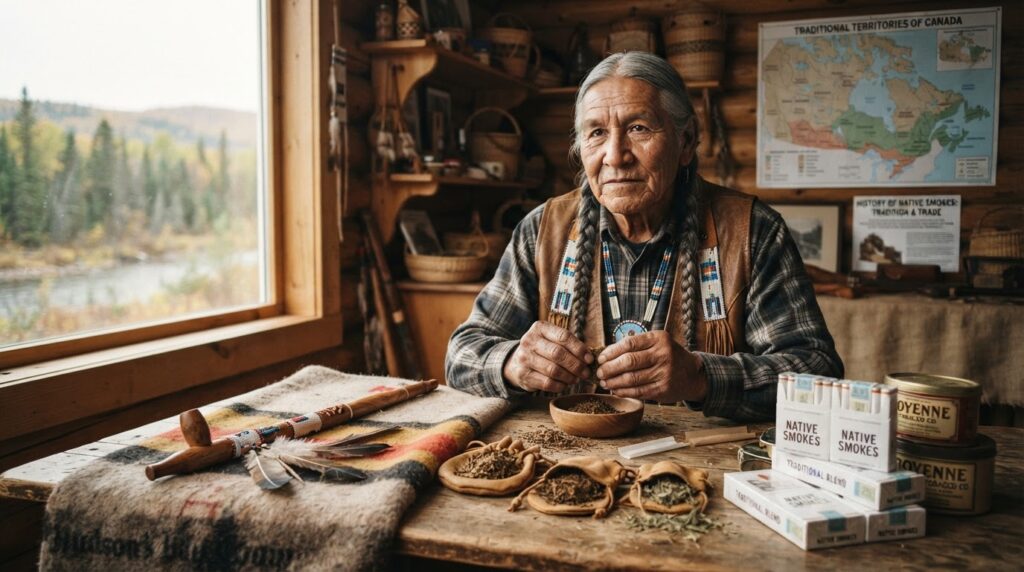
Long before European contact, tobacco already occupied a central place in the political, spiritual, and economic life of Indigenous nations across what is now Canada. Among the Haudenosaunee (Iroquois) Confederacy, the Anishinaabe, and many other nations, tobacco was cultivated as a sacred plant used in ceremony, prayer, and diplomacy. It was offered before councils were held, burned as a sign of respect when seeking guidance from elders, and used to seal agreements between nations — a practice with direct relevance to how many Indigenous leaders today frame tobacco’s role in nation-to-nation relations with Canada.
Tobacco was also a significant trade commodity, moving along extensive Indigenous trade networks that connected the Great Lakes, the St. Lawrence Valley, and territories far beyond. Indigenous nations were cultivating, processing, and trading tobacco as a valuable good centuries before Canada existed as a political entity, and long before Canadian tax law had any concept of a cigarette. This history matters directly to the modern sovereignty argument: Indigenous leaders and legal scholars point out that the right to grow, manufacture, and trade tobacco was never granted by Canada in the first place, and therefore cannot be legitimately restricted or revoked by Canada now. As Mohawk lawyer and advocate Pamela Palmater has written, the Indigenous tobacco trade is an essential part of the traditional and modern cultural practices and economies of many Indigenous nations, and remains protected by the inherent, Aboriginal, and treaty rights that predate Confederation.
This distinction between a right that is granted and a right that is recognized runs through nearly every legal and political argument examined in this article. Canadian courts have increasingly accepted, at least in principle, that Aboriginal and treaty rights protected under Section 35 of the Constitution Act, 1982 are pre-existing rights that the Constitution recognizes and affirms rather than creates from nothing. Applied to tobacco specifically, this means the relevant legal question in most of the disputes described below is not whether Canada has chosen to permit Indigenous tobacco trade as a matter of policy generosity, but whether Canada has any legitimate constitutional authority to restrict a trade practice that Indigenous nations were already exercising, under their own governance systems, long before Canadian sovereignty was asserted over their territories at all.
The Indian Act and the Legal Roots of Tax Exemption
The modern legal framework most directly tied to on-reserve tobacco sales is Section 87 of the Indian Act, which states that the personal property of a status Indian, or a band, situated on a reserve is exempt from taxation. It is important to understand what this provision actually represents, because it is frequently mischaracterized in public debate as a special tax break or loophole. Legal analysis from firms specializing in Indigenous law, including a detailed review published by Gowling WLG, traces the exemption to a much deeper historical source: Indigenous exemption from Canadian tax predates Confederation entirely and reflects the foundational cooperative principles of the early Crown-Indigenous relationship. The Supreme Court of Canada has stated plainly that the exemption was rooted in the promises made to Indians that they would not be interfered with in their mode of life — meaning Section 87 was never conceived as a favour extended by Canada, but rather a codification of a relationship of non-interference that First Nations understood themselves to have secured through historical treaty-making.
Because tobacco became one of the most heavily taxed consumer products in Canada over the twentieth century, this pre-existing exemption for reserve property took on outsized economic significance once mass-market cigarettes appeared. A status First Nations individual purchasing tobacco on reserve pays federal excise duty but not the provincial and additional federal sales taxes that make up the bulk of the retail price elsewhere in Canada — a gap that research has placed at roughly 40 percent or more of the total per-carton price in various provincial comparisons. Provinces have built formal administrative systems around this reality; Ontario, for instance, operates a First Nations Cigarette Allocation System, sometimes called the cigarette quota, which authorizes status individuals to buy a set volume of tax-exempt cigarettes on reserve for their own use under the provincial Tobacco Tax Act.
Self-Government, Modern Treaties, and a Shifting Federal Policy
Tobacco sovereignty cannot be separated from Canada’s broader, and still evolving, policy toward Indigenous self-government. For decades, Canada’s approach to modern treaty and self-government negotiations required Indigenous governments to agree to phase out the Section 87 tax exemption as a condition of reaching a final self-government agreement — a requirement that many Indigenous leaders and legal observers identified as a serious disincentive to pursuing self-government in the first place. That changed in 2022. According to testimony given to the House of Commons Standing Committee on Indigenous and Northern Affairs in 2024, Canada formally altered its approach following extensive engagement with Indigenous partners, ending the requirement to phase out the exemption and making it available for continuation on Indigenous governments’ former reserves, as well as on other First Nations reserves, for both existing and future modern treaty beneficiaries registered under the Indian Act.
Legal analysts have described this shift as removing a major structural barrier to self-determination. The policy change effectively acknowledges what many First Nations had argued for years: that requiring a nation to give up a treaty-rooted tax protection as the price of exercising its inherent right to self-government was itself a contradiction. Many modern treaties also now include provisions enabling direct taxation by Indigenous governments themselves, or tax-sharing arrangements with Canada, which are explicitly framed by the federal government as supporting self-determination and promoting economic development in Indigenous communities. Tobacco taxation authority, in this sense, has become one of the concrete, negotiable elements of what Indigenous economic self-government can look like in practice, rather than remaining purely symbolic.
UNDRIP and the Legal Weight of Economic Self-Determination
A parallel and reinforcing legal development came in 2021, when Canada passed Bill C-15, the United Nations Declaration on the Rights of Indigenous Peoples Act, formally committing the federal government to aligning Canadian law with the UN Declaration on the Rights of Indigenous Peoples. The Act’s preamble explicitly states that the Government of Canada recognizes that all relations with Indigenous peoples must be based on the recognition and implementation of the inherent right to self-determination, including the right of self-government, and the legislation directs that it is to be construed as upholding the rights recognized and affirmed by the Declaration and by Section 35 of the Constitution Act, 1982 — not as diminishing them in any way. According to the Department of Justice’s own published guidance on the Act, the underlying Declaration contains multiple provisions specifically recognizing and emphasizing the importance of economic self-determination as a key contributor to sustainable and equitable development for Indigenous peoples.
For tobacco sovereignty specifically, UNDRIP’s economic self-determination provisions add meaningful legal and interpretive weight to arguments Indigenous leaders have made for decades. Courts have already begun citing the Declaration as an aid to interpreting Canadian law, and Bill C-15 obligates the federal government to develop and report annually on a national action plan aligning its own laws and policies with the Declaration’s principles. While UNDRIP implementation has not, by itself, resolved the tobacco tax and enforcement disputes described throughout this article, it has strengthened the broader legal and political framework within which Indigenous nations argue that their historic economic practices, including tobacco cultivation, manufacturing, and trade, deserve recognition and protection rather than criminalization.
Indigenous-Owned Manufacturing as an Exercise of Sovereignty
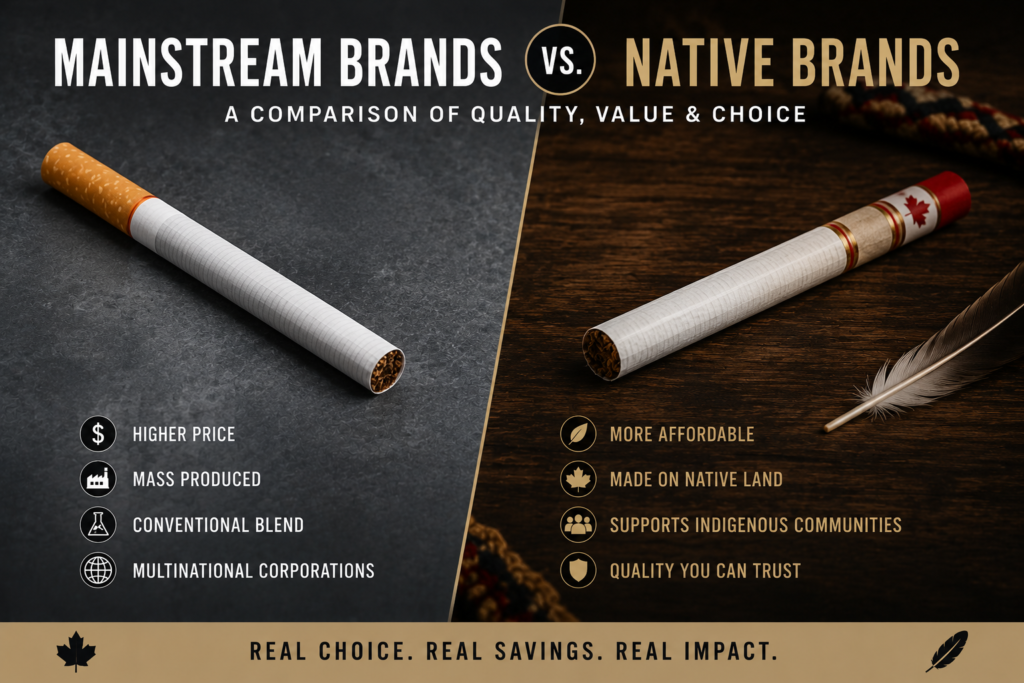
Nowhere is the sovereignty argument made more concretely than in the rise of Indigenous-owned tobacco manufacturing over the past four decades. Beginning in the 1980s and accelerating through the 1990s, First Nations communities in Ontario and Quebec established their own licensed tobacco manufacturing operations directly on reserve land, moving beyond simple tax-exempt resale of mainstream commercial brands and into full-scale, Indigenous-owned production. Six Nations of the Grand River in Ontario became home to Grand River Enterprises, founded in 1996, which grew into one of the largest tobacco manufacturers in the country and built an international distribution network exporting product well beyond Canada’s borders. Kahnawake, a Mohawk territory near Montreal, developed a parallel manufacturing sector anchored by companies including Rainbow Tobacco, which has pursued its own distribution ambitions into Western Canada and has been involved in extended legal disputes with provincial governments over the right to ship product across provincial lines.
For the communities involved, this is not simply a business story — it is explicitly framed as an assertion of nationhood. In a joint statement issued in 2016, the Mohawk Council of Kahnawà:ke and the Elected Council of Six Nations of the Grand River declared unambiguously that Kahnawà:ke and Six Nations have the legal right to produce, distribute, and trade tobacco, and that any attempt to regulate or restrict a First Nation from manufacturing and participating in inter-nation trade within the tobacco industry is an attack on this inherent Indigenous right. Kahnawake Grand Chief Joseph Tokwiro Norton stated at the time that tobacco is a natural product used for centuries, first in ceremony and later in trade, and argued that European settlers effectively appropriated an Indigenous product and then criminalized Indigenous participation in its trade. Then–Six Nations Chief Ava Hill went further, stating directly that as sovereign nations, the federal and provincial governments have no jurisdictional right to tax and regulate tobacco on their territories.
The economic scale behind these political statements is substantial. Grand River Enterprises alone has grown into a globally exporting manufacturer employing hundreds of people directly on the Six Nations reserve, with additional spinoff employment in trucking, packaging, retail, and administration supporting the wider on-reserve economy. Kahnawake’s tobacco sector plays a comparably significant role in the local economy, and RCMP figures cited in APTN reporting suggest that at points over the past two decades, tobacco manufactured on Mohawk territories has represented as much as half of all cigarettes consumed in Ontario and Quebec combined. For reserve communities that have historically faced severe barriers to conventional economic development — including Indian Act restrictions on using reserve land as loan collateral, chronic underinvestment in on-reserve infrastructure, and geographic isolation in many cases — an Indigenous-owned, Indigenous-operated industry generating this level of employment and revenue represents a genuinely significant departure from the pattern in which resource wealth connected to Indigenous lands has historically flowed primarily to non-Indigenous corporations and governments. Beyond Six Nations and Kahnawake, smaller-scale tobacco retail and manufacturing operations have also taken root on reserves in other provinces, including parts of Manitoba, Saskatchewan, and Alberta, extending the same basic economic model — and the same underlying sovereignty argument — well beyond its original Ontario and Quebec base.
A Landmark Legal Recognition: The 2023 Kahnawake Ruling
The sovereignty argument moved from political statement to binding legal precedent in 2023, when a Quebec Superior Court judge issued what Indigenous legal observers consider one of the most significant tobacco-related rulings in recent Canadian history. As reported by CBC News, Justice Sophie Bourque ruled that the Kanien’kehá:ka (Mohawk) people hold a treaty right to trade tobacco, grounding her decision in the historic Covenant Chain relationship between the Haudenosaunee Confederacy and the Crown — a relationship understood, in the words of lawyer Paul Williams, who represented Six Nations interests in the case, as existing almost entirely inside Indigenous legal systems rather than inside the Crown’s common law system. The proceedings ran from October 2021 to April 2022, and notably included the Mohawk Nation Council of Chiefs, a traditional government body distinct from the elected band council structure imposed by the Indian Act, which was authorized to intervene and present evidence of a specifically Kanien’kehá:ka legal and cultural perspective on the trade.
Kahnawake Grand Chief at the time, Kahsennenhawe Sky-Deer, stated that the ruling reflected a judge who meaningfully understood the true essence of the nation-to-nation relationship between the Haudenosaunee and Canada. The decision has since become a reference point in ongoing disputes between Mohawk tobacco manufacturers and provincial governments. In one such dispute reported by APTN News, Rainbow Tobacco president Robbie Dickson pursued litigation against the Quebec government worth several million dollars after provincial seizures of tobacco products manufactured in Kahnawake, arguing that trading tobacco between nations is an inherent right that Mohawk people have exercised since long before European contact. According to an RCMP report cited in that coverage, by 2011 tobacco manufactured on Mohawk territories accounted for roughly half of all cigarettes consumed in Ontario and Quebec — a striking figure that underscores just how large-scale Indigenous-led manufacturing has become, whatever position one takes on its legality relative to provincial tax law.
Sovereignty Is Also an Internal Question
One of the more nuanced dimensions of tobacco sovereignty, often missed in coverage that treats First Nations as a single unified voice, is that questions of legitimate authority over tobacco governance are actively contested within Indigenous communities themselves. At Kahnawake, a proposed Tobacco Law developed in partnership between the Mohawk Council of Kahnawà:ke and the Kahnawake Tobacco Association ran into direct opposition from the Kahnawake Longhouse, the community’s traditional government body operating under the Kaianere’kó:wa, the Great Law of the Haudenosaunee Confederacy. As reported by The Eastern Door, Kahnawake’s own community newspaper, the Longhouse argued that the Mohawk Council itself lacks the legitimacy to enact or enforce a tobacco law, describing the elected council as a colonial construct of Canada rather than a legitimate expression of Rotinonhsión:ni (Haudenosaunee) governance. The Longhouse’s position was that sovereignty over the tobacco industry flows specifically from the Kaianere’kó:wa and the Confederacy itself, not from a band council structure that exists only because it was established under the Indian Act.
This internal debate matters because it reveals that tobacco sovereignty is not simply a dispute between First Nations and the Canadian state — it is also a live conversation within Indigenous nations about which governing bodies, traditional or elected, hold rightful authority to regulate a sovereign right in the first place. Kahnawake has addressed similar governance questions before, notably through its Community Decision Making Process, a consensus-based legislative model developed specifically to bridge traditional Haudenosaunee decision-making with the practical demands of governing a modern reserve economy, and previously used to work through comparably difficult questions when the community developed its own cannabis regulations following legalization.
The Enforcement Side: Contraband, Seizures, and Competing Narratives
Canadian federal and provincial governments do not, for the most part, dispute that Section 87 creates a genuine tax exemption for eligible on-reserve purchases. Where the conflict sharpens considerably is over the much larger volume of tobacco that leaves reserve land and enters the broader Canadian market without provincial or federal tax ever being collected on it. Provincial governments, including Quebec, label large volumes of Mohawk-manufactured tobacco as contraband precisely because that province receives no tax revenue from its sale, and RCMP enforcement reports have documented extensive networks moving reserve-manufactured tobacco into general retail circulation across the country. Commentary published in regional outlets such as SaskToday has highlighted RCMP findings connecting illicit tobacco proceeds to organized crime financing, and has argued that the scale of diversion undermines the narrower, personal-use intent of the original Section 87 exemption.
First Nations governments and industry participants dispute the contraband framing on both legal and political grounds. Kahnawake and Six Nations leadership have specifically objected to law enforcement operations that, in their words, lump the legal manufacturing and trade of tobacco by Indigenous people together with organized crime activity, treating an assertion of inherent Indigenous trade rights as inherently criminal. Testimony given before the Standing Senate Committee on Legal and Constitutional Affairs captured this tension directly: one Indigenous industry representative argued that criminalizing First Nations tobacco trade functions, in practice, as an attempt to secure market share for foreign multinational tobacco companies, framing Canadian enforcement less as neutral tax administration and more as economic protectionism directed against Indigenous competitors. From this vantage point, a status First Nations individual who wants to fully exercise the trade rights described in Sections 87 and 89 of the Indian Act risks prosecution for doing so — a contradiction that Indigenous advocates argue Canada has never adequately resolved.
The Public Health Dimension
Any complete account of tobacco sovereignty also has to reckon honestly with public health data, because commercial tobacco use continues to disproportionately affect Indigenous communities in Canada. Research published in the Canadian Journal of Public Health, drawing on Health Canada data, has documented commercial tobacco use rates of roughly 40 percent among First Nations people, 49 percent among Inuit, and 37 percent among Métis peoples, compared to substantially lower rates in the general Canadian population. A separate systematic review published through the National Institutes of Health’s PubMed Central database found even starker disparities specifically for on-reserve First Nations communities, citing a commercial tobacco use rate of roughly 59 percent on-reserve, compared to about 18 percent in the general Canadian population — one of the largest documented health disparities of its kind in the country.
Public health researchers and Indigenous health organizations have been careful to draw a sharp distinction between two very different things that both fall under the word tobacco: traditional or sacred tobacco, used in ceremony and prayer in small, intentional quantities, which Indigenous health promotion campaigns explicitly protect and encourage; and commercial tobacco, the mass-manufactured cigarette product responsible for the disease burden reflected in the statistics above. Peer-reviewed research on the Ottawa Charter’s applicability to Indigenous health has argued that commercial tobacco and nicotine industries continue to exploit colonial and racial structures, perpetuating addiction, disease, and death while undermining the very sovereignty and self-determination that Indigenous nations are simultaneously asserting through their ownership of tobacco manufacturing. This creates a genuine internal tension that Indigenous public health advocates have been explicit about: an industry built on an inherent trade right and a genuine tool of economic self-determination is, at the same time, contributing to a serious and disproportionate health burden inside the very communities exercising that right. Community-led tobacco control strategies that respect economic sovereignty while addressing commercial tobacco’s health impact directly — as opposed to top-down federal restrictions imposed without Indigenous consultation — have been identified by Indigenous health researchers as the approach most likely to reduce harm without undermining the underlying sovereignty claim.
It’s worth noting that data quality itself has been identified as part of this broader problem. Researchers behind the Our Health Counts Toronto study specifically flagged that data sources used to measure Indigenous health outcomes, including commercial tobacco use, are often biased, drawn from non-random samples, or affected by high rates of non-response and misclassification — a pattern some researchers have described as a form of statistical invisibility that itself reflects the same colonial structures shaping the underlying health disparities. That means even the disparity figures cited throughout this section, stark as they already are, may not fully capture the true scope of commercial tobacco’s impact on Indigenous communities, reinforcing calls from Indigenous-led research organizations for more community-driven, Indigenous-governed health data collection going forward.
Frequently Asked Questions
What does “tobacco sovereignty” actually mean?
Tobacco sovereignty refers to the position, held by many First Nations governments and legal scholars, that Indigenous nations hold an inherent right — one that predates Canada and was never surrendered — to grow, manufacture, trade, and govern tobacco on their own territories under their own laws. It is distinct from, though related to, the narrower tax exemption created by Section 87 of the Indian Act.
Is the Section 87 tax exemption the same thing as tobacco sovereignty?
No. Section 87 is a specific, codified legal provision exempting reserve property from taxation. Tobacco sovereignty is the broader political and legal claim that Indigenous nations have inherent jurisdiction over tobacco as an economic and cultural practice, independent of what any single section of the Indian Act says. Section 87 is one legal expression of a much older relationship; it is not the source of the underlying right, according to the legal and political arguments described throughout this article.
What did the 2023 Quebec court ruling actually decide?
Quebec Superior Court Justice Sophie Bourque ruled that the Kanien’kehá:ka (Mohawk) people hold a treaty right to trade tobacco, grounding the decision in the historic Covenant Chain relationship between the Haudenosaunee Confederacy and the Crown. It is considered one of the most significant Indigenous rights rulings involving tobacco in recent Canadian legal history, and continues to shape ongoing disputes between Mohawk tobacco manufacturers and provincial governments.
Do all First Nations communities agree on how tobacco should be governed?
No. As the internal dispute at Kahnawake between the elected Mohawk Council and the traditional Longhouse government illustrates, First Nations communities themselves actively debate which governing body — an Indian Act–created band council or a traditional government structure — holds legitimate authority to regulate tobacco. Tobacco sovereignty is not a single, unified position; it is a live and ongoing conversation within Indigenous nations as much as between Indigenous nations and Canada.
Does asserting tobacco sovereignty conflict with public health goals?
Indigenous health researchers generally argue it doesn’t have to. The tension is real — commercial tobacco use rates remain disproportionately high in First Nations communities — but public health advocates distinguish between economic sovereignty over the tobacco industry itself and the separate, solvable problem of reducing commercial tobacco’s health impact through community-led, culturally grounded cessation and control strategies, rather than through externally imposed restrictions that do not address the underlying economic and jurisdictional relationship.
Where Tobacco Sovereignty Stands Today
Tobacco sovereignty in Canada today sits at an unusually active legal and political crossroads. The 2023 Quebec Superior Court ruling recognizing a Kanien’kehá:ka treaty right to trade tobacco has given Indigenous nations a stronger legal foundation than existed even five years earlier, and continues to shape ongoing litigation between Mohawk tobacco manufacturers and provincial governments. Canada’s 2022 policy shift on modern treaties and the Section 87 exemption removed a significant structural obstacle that had discouraged First Nations from pursuing self-government agreements. At the same time, provincial and federal enforcement agencies continue to treat large volumes of reserve-manufactured tobacco moving into general retail circulation as contraband, and public health data continues to show that commercial tobacco use extracts a disproportionate toll on the very communities whose economic sovereignty is tied to its production.
What makes tobacco sovereignty a genuinely complex subject, rather than a simple story with a clear right and wrong side, is that all of these things are true simultaneously: tobacco’s role in Indigenous nationhood and diplomacy long predates Canada; Section 87’s tax exemption is a codification of historic promises rather than a modern loophole; Indigenous-owned manufacturing represents a real and growing exercise of economic self-determination; legitimate governance authority over that industry is still being worked out inside Indigenous nations themselves; large-scale diversion into the broader Canadian market creates a genuine and unresolved legal conflict with provincial tax authorities; and the health costs of commercial tobacco use fall hardest on First Nations, Inuit, and Métis communities. Any serious understanding of tobacco sovereignty in Canada needs to hold each of these realities in view at once, rather than collapsing the issue into either an unqualified defence of Indigenous industry or a simple story about tax evasion. It is, in the end, a story about what economic self-determination actually looks like in practice for nations still working, case by case and court by court, to have their sovereignty recognized on their own terms.
The years ahead are likely to bring further clarification rather than final resolution. Litigation stemming from the 2023 Kahnawake ruling continues to work its way through Quebec’s courts, Canada’s UNDRIP action plan obligations under Bill C-15 are still being implemented, and provinces continue to negotiate, sometimes uneasily, with Indigenous governments over how tobacco taxation and enforcement should function going forward. What seems unlikely to change is the underlying claim itself: that tobacco sovereignty, for the nations asserting it, was never something Canada gave and is therefore not something Canada can simply take away.
Sources
- Appearance before the Standing Committee on Indigenous and Northern Affairs — Taxation, Revenue and Economic Reconciliation — Crown-Indigenous Relations and Northern Affairs Canada
- Self-government — Crown-Indigenous Relations and Northern Affairs Canada
- Bill C-15: An Act Respecting the United Nations Declaration on the Rights of Indigenous Peoples — Department of Justice Canada
- Questions and Answers – Bill C-15 — Department of Justice Canada
- First Nations Cigarette Allocation System — Government of Ontario
- Indigenous self-government and taxation — Gowling WLG
- Quebec judge rules Kanien’kehá:ka have treaty rights to trade tobacco — CBC News
- Kahnawà:ke grand chief says nation-to-nation trade must not be interrupted — APTN News
- Tobacco battle flares in two more provinces — APTN News
- Kahnawake and Six Nations Exercising Inherent Right to Participate in Tobacco Trade — Mohawk Council of Kahnawà:ke / Six Nations Elected Council (Newswire)
- The Kahnawake tobacco law tug of war — The Eastern Door
- The Kahnawake Community Decision Making Process — Participedia
- Canada’s Criminalization of the Indigenous Tobacco Trade — Dr. Pamela Palmater
- Transcripts & Minutes — Standing Senate Committee on Legal and Constitutional Affairs
- Our Health Counts Toronto: Commercial tobacco use among Indigenous peoples in Toronto — Canadian Journal of Public Health (PMC/NCBI)
- Effective strategies to reduce commercial tobacco use in Indigenous communities globally: A systematic review — BMC Public Health (PMC/NCBI)
- The Ottawa Charter: Indigenous sovereignty, resistance, and health promotion at 40 (PMC/NCBI)