How tobacco, treaty rights, and reserve economies shaped one of Canada’s most complicated industries
Long before “Native smokes” became a familiar phrase at gas stations and smoke shops across Ontario, Quebec, and beyond, tobacco already held a central place in the lives of Indigenous peoples in what is now Canada. Today, Native cigarettes are a fixture of the Canadian tobacco landscape — sold on reserve lands from coast to coast, discussed constantly online, and wrapped up in a legal and economic story that stretches back centuries. Understanding how Native smokes in Canada came to exist in their current form means understanding tobacco’s traditional role in Indigenous culture, the treaty and legal framework that created tax-exempt sales, the rise of on-reserve manufacturing as a genuine economic engine, and the ongoing tension between legitimate Indigenous commerce and the contraband trade that has grown up around it.
Tobacco’s Deep Roots in Indigenous Canada
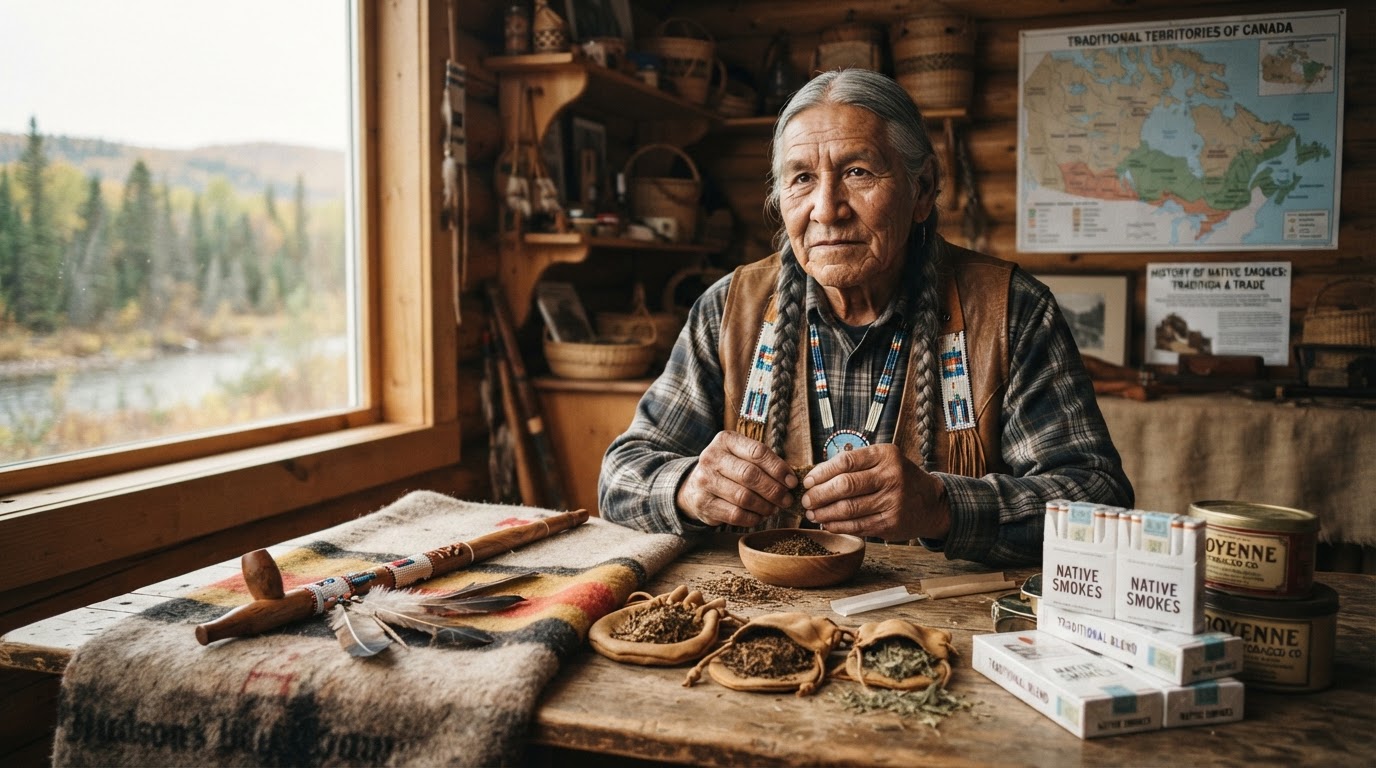
Tobacco is not a modern industry invention — it is one of the oldest cultivated plants in North America, and Indigenous peoples across what is now Canada have grown, traded, and used tobacco for well over a thousand years. Long before European contact, nations such as the Haudenosaunee (Six Nations), Anishinaabe, and Wendat cultivated tobacco as a sacred plant, used in ceremony, prayer, and as an offering of respect between individuals, communities, and nations. Tobacco was smoked in pipe ceremonies to seal agreements, offered to elders as a sign of respect before asking for guidance, and burned as part of spiritual practice tied to gratitude and connection to the land.
This traditional tobacco, sometimes called sacred tobacco or ceremonial tobacco, was fundamentally different from the commercial cigarette products sold today. It was typically a distinct plant variety, used sparingly and intentionally rather than consumed recreationally or habitually. That distinction matters, because it is easy for outside observers to conflate today’s commercial Native cigarettes industry with these much older cultural practices. In reality, the two are related mainly by geography and the fact that both fall under the broader banner of tobacco grown, processed, or sold by Indigenous communities in Canada — the ceremonial and the commercial are separate traditions that happen to share a name.
Tobacco also played an important economic role long before Confederation. Indigenous nations across the Great Lakes region and the St. Lawrence Valley cultivated tobacco as a trade good, exchanging it along extensive intertribal trade networks that moved goods across enormous distances, connecting communities as far apart as the eastern woodlands and the prairies. Cultivation of tobacco by Wendat and Haudenosaunee farmers was sophisticated enough that early French and English colonial accounts frequently commented on the scale and organization of Indigenous tobacco fields, which supplied not only local ceremonial and social use but also regional trade far beyond any single community’s own borders.
When European traders arrived in the sixteenth and seventeenth centuries, tobacco quickly became one of the most sought-after commodities in the emerging colonial trade economy, prized by newcomers who had never encountered the plant before and who rapidly adopted smoking as a European habit exported back across the Atlantic. Indigenous nations found themselves supplying both traditional trade partners and an entirely new colonial market simultaneously, a dynamic that gradually pulled tobacco away from its purely ceremonial role and toward the beginnings of a cash-crop commodity economy — setting the stage for tobacco’s transformation from a sacred, small-scale crop into the mass commercial product Canadians recognize today.
Colonization, the Indian Act, and the Roots of Tax Exemption
The legal foundation for today’s tax-exempt Native cigarettes in Canada traces back to the Indian Act, the piece of federal legislation first passed in 1876 that continues to govern much of the legal relationship between the Canadian government and status First Nations individuals and bands. Section 87 of the Indian Act states that the personal property of a status Indian, or a band, situated on a reserve is exempt from taxation. This provision was not written with cigarettes specifically in mind — it reflects a much broader principle, rooted in treaty relationships and the recognition that reserve lands hold a distinct legal status within Canada, separate from provincial and municipal taxation regimes that apply elsewhere.
Over the twentieth century, as commercial tobacco products became a fixture of everyday Canadian life and governments began taxing cigarettes heavily to fund public programs and, later, to discourage smoking, Section 87 took on new significance. Because reserve land was already recognized as tax-exempt territory for status First Nations individuals, tobacco products sold on reserve to status buyers were, by extension, also exempt from the provincial and federal sales taxes that drive up the price of a pack of cigarettes everywhere else in Canada. This is the legal root of what most Canadians now casually refer to as Native smokes: cigarettes sold on First Nations reserve land, tax-free, to status First Nations purchasers, under a framework that predates the modern tobacco industry by roughly a century.
It’s worth being precise about who this exemption actually covers. Provincial tobacco tax bulletins across the country — from Ontario to Manitoba to British Columbia — define eligibility narrowly: a purchaser must hold a valid Certificate of Indian Status or equivalent federal documentation confirming registration under the Indian Act, and the purchase must take place on reserve land for the buyer’s own use. Several provinces, including Ontario, formalize this further through an allocation system, sometimes called a cigarette quota, in which the provincial government calculates a set volume of tax-exempt cigarettes each reserve retailer is permitted to sell per year, based on the size of the eligible population. Packages sold under this system carry a distinct federal stamp, separate from the stamps used on fully taxed retail cigarettes.
Key Court Battles That Shaped the Tax Exemption
The modern scope of Section 87 wasn’t settled by the plain text of the Indian Act alone — it was shaped over decades by litigation. In Nowegijick v. The Queen (1983), the Supreme Court of Canada took an expansive view of the exemption, ruling that wages earned by a status Indian could be tax-exempt where the employer was situated on reserve, and establishing an interpretive principle that ambiguity in Indian Act provisions should generally be resolved in favour of Indigenous claimants. In Mitchell v. Peguis Indian Band (1990), the Court further affirmed that the purpose of the tax exemption was to protect reserve property and the economic base of reserve communities from erosion by outside governments, reinforcing the exemption as a matter of protecting Indigenous land and livelihood rather than a narrow accounting technicality.
Tobacco and fuel specifically became their own battleground in British Columbia in the early 1990s, when the Tseshaht First Nation near Port Alberni challenged the province’s tobacco and fuel tax allocation system in court, arguing that limiting the quantity of tax-exempt product a band retailer could purchase infringed on the community’s rights under the Indian Act. A trial court initially agreed, but the BC Court of Appeal overturned that decision in 1992, ruling that the tax exemption does not extend to retailers purchasing tobacco in bulk for resale, and that provinces retain authority to regulate the volume of tax-exempt product moving through reserve retailers. That ruling gave provinces the legal basis to reintroduce and maintain the allocation systems that still govern on-reserve tobacco retail in much of Canada today. More recently, litigation involving Grand River Enterprises itself has tested how far the exemption extends into large-scale manufacturing and export activity, underscoring that the legal boundaries of tax-exempt Native cigarettes production remain an active, evolving area of Canadian law rather than a settled question from a century ago.
The Rise of On-Reserve Tobacco Manufacturing
For much of the twentieth century, tax-exempt tobacco sales on reserve simply meant status buyers purchasing mainstream commercial cigarette brands without paying the tax portion of the price. That began to change significantly in the 1980s and 1990s, when First Nations communities in Ontario and Quebec began establishing their own licensed tobacco manufacturing operations directly on reserve land. This marked the beginning of the modern Native cigarettes industry as most Canadians would recognize it today — an industry built not just around tax-exempt resale of existing brands, but around Indigenous-owned companies growing, blending, rolling, and packaging their own cigarette products from the ground up.
The most prominent example is Grand River Enterprises, founded on the Six Nations of the Grand River reserve near Brantford, Ontario, in 1996. Grand River Enterprises grew rapidly into one of the largest tobacco manufacturers in Canada, eventually ranking among the country’s top producers by volume and exporting product internationally. Six Nations became closely associated with brands such as DK’s and Putters, among others, cementing the reserve’s reputation as a manufacturing hub for the broader Native cigarettes market in Canada. Kahnawake, a Mohawk territory on the south shore of the St. Lawrence River near Montreal, developed a parallel tobacco manufacturing and retail sector of its own, becoming another major production centre for Native smokes sold across Quebec and beyond.
Akwesasne, a Mohawk territory that straddles the Canada–U.S. border along the St. Lawrence River near Cornwall, Ontario, occupies a particularly unusual position in this history. Its geography places parts of the community under Canadian federal and provincial jurisdiction, parts under Quebec, parts under Ontario, and parts under New York State and the United States federal government simultaneously — a jurisdictional patchwork that has made Akwesasne one of the most significant hubs for tobacco movement in North America, for both licensed and unlicensed product. Tyendinaga Mohawk Territory near Belleville, Ontario, developed into another major retail centre, with a dense concentration of on-reserve smoke shops selling Native cigarettes to both status and non-status customers along the well-travelled Highway 401 corridor.
By the 2000s, on-reserve tobacco manufacturing and retail had become a substantial economic sector in its own right, generating employment in growing, curing, processing, packaging, distribution, and retail — jobs that, in many cases, exist in communities with historically limited access to large-scale private-sector employment. For a number of First Nations, tobacco manufacturing and retail became one of the largest sources of on-reserve jobs and locally generated revenue, supporting not just individual livelihoods but, in some cases, community infrastructure, band-run programs, and local development projects.
What’s Actually on the Shelf: Native Cigarette Brands in Canada
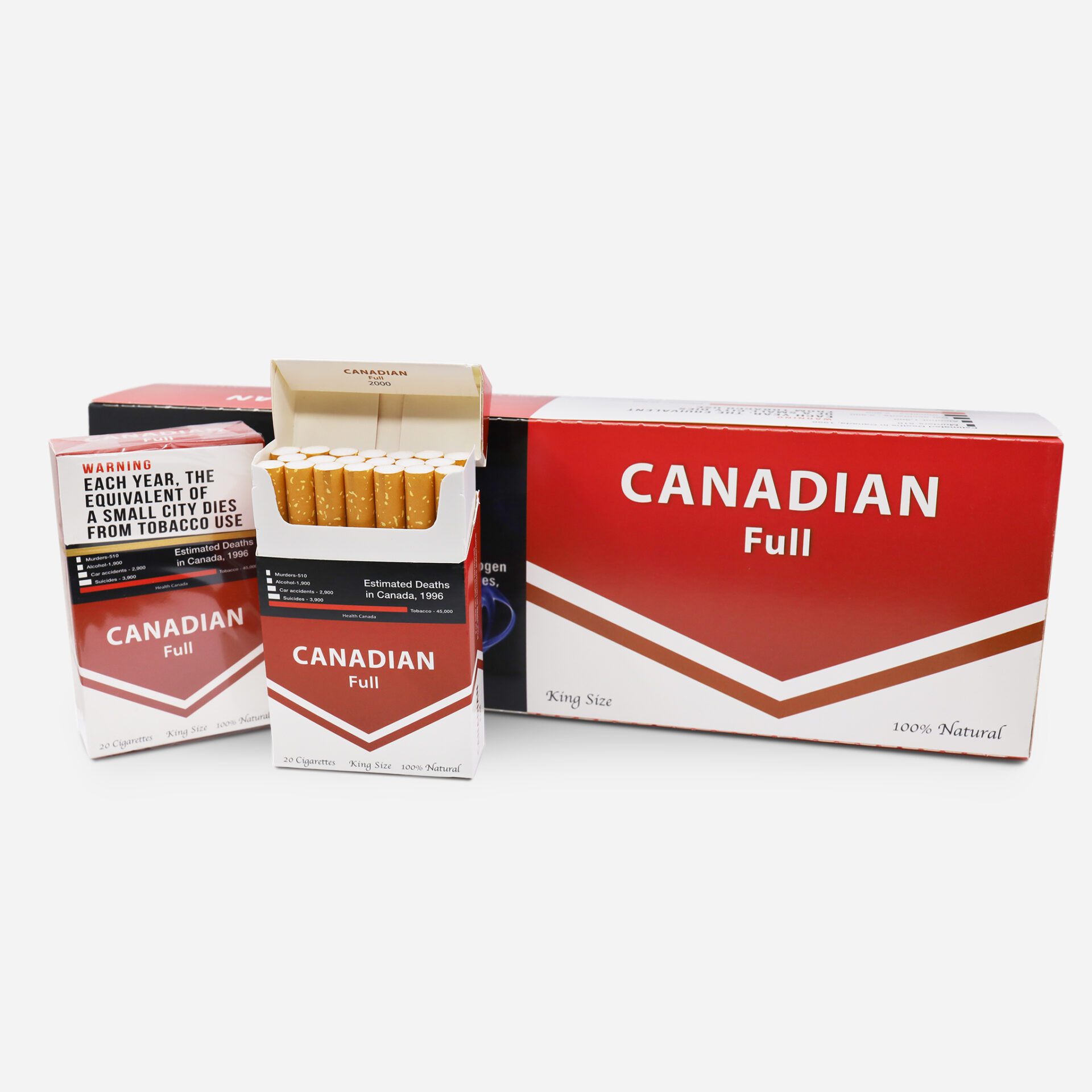
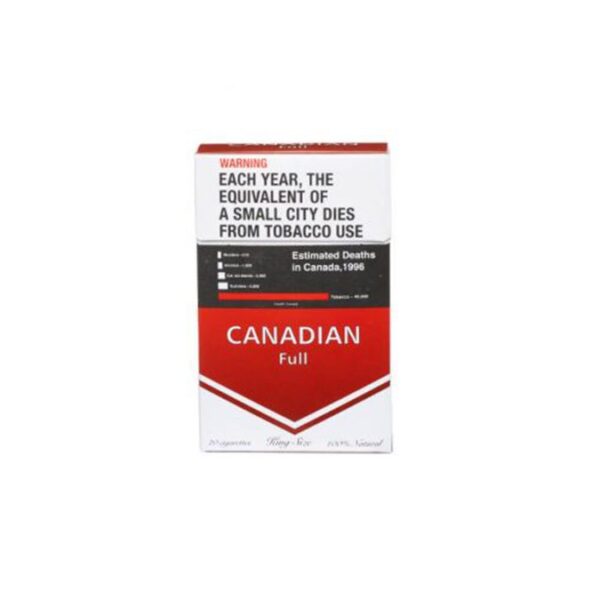
Walk into a smoke shop on Six Nations, Tyendinaga, or Kahnawake today and the brand names on display look nothing like the familiar red-and-gold packaging of mainstream Canadian tobacco companies. Reserve-manufactured Native cigarettes are typically sold under their own distinct brand identities — names like DK’s, Putters, Sago, and Canadian have circulated across Ontario reserve retail for years, alongside a rotating cast of smaller regional labels tied to specific manufacturers. Packaging tends to be simpler than mainstream commercial cigarettes, often without the extensive graphic health warnings and standardized plain packaging design mandated for cigarettes sold through provincially licensed retailers off reserve, since on-reserve tax-exempt sales operate under a partially separate regulatory track from the general retail tobacco market.
This branding distinction matters for anyone searching for information on Native smokes in Canada, because these products are genuinely different consumer goods from the mainstream cigarette brands sold at any gas station or convenience store — different manufacturers, different supply chains, different tax treatment, and, in many cases, a price point that can run at a fraction of what a comparably sized carton costs once federal and provincial tobacco taxes are added at an off-reserve retailer.
A Province-by-Province Patchwork
Because tobacco taxation in Canada is split between federal excise duty and provincial sales tax, and because provinces retain significant discretion over how they administer the Section 87 exemption, the rules governing Native cigarettes look meaningfully different depending on where in Canada you are. Ontario relies on its allocation system, licensing reserve wholesalers and retailers and capping the annual volume of tax-exempt cigarettes each reserve can receive, with compliance tracked through the province’s Tobacco Tax Act. British Columbia operates a broadly similar allocation model following the Tseshaht litigation of the early 1990s, requiring reserve retailers to track and report sales for tax compliance purposes even though the products themselves remain tax-exempt for eligible buyers. Quebec, home to Kahnawake, has developed its own enforcement partnership between provincial and federal agencies, largely because of the scale of tobacco manufacturing and distribution concentrated in a small number of Quebec-based reserve communities. Alberta permits on-reserve production and sale but regulates off-reserve movement of that product strictly, reflecting a pattern common across the Prairie provinces as reserve-based tobacco retail has expanded there in recent years.
This provincial patchwork means that the practical experience of buying, selling, or manufacturing Native cigarettes in Canada can vary substantially depending on which reserve, and which province, is involved — even though the underlying federal legal foundation, Section 87 of the Indian Act, is the same coast to coast.
The Economic and Sovereignty Argument for Native Smokes
The case that many First Nations leaders and community members make for the tobacco industry rests on more than just price. It’s an argument about economic self-determination. Reserve communities in Canada have faced, and continue to face, some of the most difficult economic conditions in the country, shaped by more than a century of Indian Act restrictions on property rights, limited access to capital and credit, remote geography in many cases, and chronic underinvestment in on-reserve infrastructure. Against that backdrop, an industry that First Nations communities can own, operate, staff, and profit from directly — rather than one imposed or controlled by outside corporations — represents a meaningful exercise of economic sovereignty.
This argument is closely tied to the broader legal and political concept of Indigenous self-government and treaty rights. Many First Nations leaders frame the tax-exempt status of on-reserve tobacco sales not as a loophole or a special favour, but as one of the few tangible, functioning expressions of nation-to-nation treaty relationships and inherent jurisdiction over reserve lands that Canada has actually honoured in practice. From this perspective, purchasing Native smokes on reserve, for those legally entitled to do so, is understood as participating directly in a First Nations-owned and First Nations-operated economy, with revenue and employment staying within the community rather than flowing to large multinational tobacco corporations headquartered far from reserve lands.
Communities such as Six Nations and Kahnawake point to real, measurable outcomes tied to their tobacco sectors: hundreds of direct manufacturing jobs, spinoff retail and transportation employment, and, in the case of companies like Grand River Enterprises, significant export revenue that flows back into the local economy. Advocates argue that this stands in sharp contrast to the historical pattern in which resource wealth extracted from or near Indigenous lands — timber, minerals, hydroelectric power — has overwhelmingly benefited non-Indigenous corporations and governments while First Nations communities themselves saw comparatively little direct economic return.
Beyond direct manufacturing jobs, the on-reserve tobacco sector has also fed a wider circle of secondary economic activity: trucking and distribution companies moving product between reserves and wholesalers, packaging and printing suppliers, retail construction, and administrative and accounting work supporting band-owned enterprises. In communities where unemployment has historically run well above the national average, and where private investment capital has often been difficult to attract given the unique legal status of reserve land under the Indian Act, this kind of diversified, locally rooted economic activity carries weight well beyond the tobacco products themselves. Some bands have used tobacco-related revenue to help fund community infrastructure projects, from roads and water systems to recreational and cultural facilities, treating the industry as a genuine, if imperfect, tool for closing long-standing gaps in reserve infrastructure investment.
Supporters of the industry also point out that Indigenous-owned tobacco companies operate under many of the same federal manufacturing, licensing, and packaging obligations that apply to any Canadian tobacco producer — they are inspected, licensed by the Canada Revenue Agency, and subject to federal tobacco product regulations, even as their retail sales to status buyers remain tax-exempt. From this vantage point, framing all on-reserve tobacco activity as inherently illegitimate ignores a genuinely licensed, regulated manufacturing sector that simply happens to be Indigenous-owned and headquartered on reserve land, rather than owned by a multinational tobacco conglomerate headquartered in Toronto, London, or New York.
At the same time, this economic argument exists inside a legal and public health picture that is genuinely more complicated than a simple story of community benefit, and any honest account of Native cigarettes in Canada has to reckon with both sides.
Where the Legal Framework Gets Complicated
The tax exemption under Section 87 of the Indian Act was designed for a narrow purpose: it exempts status First Nations individuals from taxation on personal property, including tobacco, purchased on reserve for their own use. It was never intended to create a general tax-free retail zone open to the entire Canadian public, and provincial tobacco tax law is explicit on this point. In Ontario, British Columbia, Manitoba, and every other province with a significant on-reserve tobacco sector, the tax exemption legally applies only to status First Nations purchasers buying on reserve land for personal consumption.
In practice, enforcement of that boundary has been extremely difficult, and a large share of Canada’s on-reserve tobacco production and retail has ended up supplying buyers well outside that narrow legal category. Some of this happens informally, through smoke shops that sell to any customer willing to make the drive. Some of it happens at industrial scale, through organized distribution networks that purchase or divert tax-exempt product and move it into the general population — and, in the most serious cases, across the Canada–U.S. border — without any tax ever being collected on it. The RCMP has documented this activity extensively, and Canadian law enforcement generally treats the diversion of tax-exempt reserve tobacco to non-eligible buyers, and the unlicensed manufacturing that sometimes accompanies it, as contraband.
This is a genuinely important distinction for anyone trying to understand Native smokes in Canada, because the same words — Native cigarettes, Native smokes, reserve cigarettes — get used to describe two very different things: fully legal, tax-exempt sales to status First Nations buyers on reserve, and an illegal secondary market that piggybacks on that legal framework to sell untaxed tobacco to the general public. Both exist. Both are large. And conflating them, in either direction, misrepresents what’s actually happening across Canada’s reserve tobacco economy.
Contraband, Organized Crime, and the Public Cost
The scale of the illegal side of this market is significant enough that it has become a standing law enforcement priority in Canada. The RCMP’s Contraband Tobacco Enforcement Strategy, launched in 2008, was created specifically to address the diversion of reserve-manufactured tobacco into the broader illicit market. More recent RCMP estimates put the number of criminal organizations involved in Canada’s illicit tobacco trade at over 170, with a substantial share of those groups also involved in drug trafficking, weapons trafficking, and other organized crime activity. Financial intelligence agencies have flagged large volumes of suspicious financial transactions connected to tobacco trafficking routed through reserve communities, particularly Akwesasne and Kahnawake, given their strategic position along the Canada–U.S. border.
Research using Canada’s long-running International Tobacco Control survey found that on-reserve cigarette purchasing by non-status smokers in Ontario rose sharply over the 2000s and into the 2010s, reaching roughly a quarter of surveyed smokers reporting their last cigarette purchase came from a reserve by 2013–2014, up from a small fraction a decade earlier. That volume of untaxed sales represents a substantial loss in provincial and federal tax revenue, money that would otherwise fund public health programs, smoking cessation initiatives, and general government services. Industry and policy researchers have estimated Canada’s contraband tobacco market, of which diverted reserve tobacco makes up a significant share, at many hundreds of millions of dollars annually in lost tax revenue.
First Nations leadership is far from unified or silent on this issue. A number of chiefs and band councils have publicly expressed concern about organized crime infiltrating tobacco operations on or near their territories, about the reputational damage done to legitimate on-reserve businesses when illegal operations are lumped in with them, and about the genuine social harms that flow into their own communities when black-market activity takes root. Fighting contraband tobacco while defending legitimate on-reserve economic activity has proven to be a genuinely difficult balancing act — one that pits communities’ interest in economic self-determination against governments’ interest in tax enforcement, and both against the reality that organized crime has found real profit in exploiting the gap between the two.
The Health Picture on Reserve
Any complete history of Native smokes in Canada also has to address public health, because tobacco’s impact on First Nations, Inuit, and Métis communities has been disproportionately severe. Smoking rates among First Nations adults living on reserve have consistently been measured at roughly two to three times the national Canadian average, according to Health Canada and First Nations health survey data collected over the past two decades. That gap reflects a complex mix of factors, including the intergenerational trauma tied to colonization and residential schools, socioeconomic conditions on many reserves, historically limited access to smoking cessation resources and health care infrastructure, and — researchers and public health bodies have specifically noted — the easy availability of very low-cost cigarettes through the same on-reserve tobacco economy that provides jobs and revenue to these same communities.
This creates a genuine tension inside many First Nations communities themselves. The tobacco industry that supports jobs, band revenue, and economic sovereignty is, at the same time, supplying some of the cheapest cigarettes available anywhere in Canada directly into communities already dealing with elevated smoking-related illness, from cardiovascular disease to respiratory illness to elevated cancer rates. Several First Nations public health organizations have called for community-led tobacco control strategies that respect economic sovereignty while addressing this health burden directly, an approach that tries to separate sacred, ceremonial tobacco use — which many public health campaigns explicitly support and protect — from commercial cigarette consumption, which is the actual driver of the health statistics.
Youth smoking initiation is another area of particular concern flagged by First Nations health researchers, since easy access to very low-cost cigarettes on or near reserve land has been associated with earlier smoking initiation among young people in some studies, at a time when youth smoking rates in the general Canadian population have fallen substantially due to decades of tax-driven price increases and public health campaigns. Because the tax-exempt price advantage of Native cigarettes partially insulates on-reserve smokers from the price signal that has been one of Canada’s most effective tools for reducing smoking nationally, some public health researchers argue that reserve communities have not benefited as much from the country’s broader decline in smoking rates as the rest of the population has, even as those same communities have supplied a growing share of the country’s overall cigarette consumption.
Common Questions About Native Smokes in Canada
Is it legal to buy Native cigarettes in Canada?
It depends entirely on who is buying and where. It is legal for a status First Nations individual to purchase tax-exempt Native cigarettes on reserve land, under the framework created by Section 87 of the Indian Act and administered through provincial allocation systems. It is generally not legal for a non-status buyer to purchase tax-exempt tobacco, and provincial tobacco tax law in most of Canada treats off-reserve resale, shipping, or possession of untaxed reserve cigarettes by non-eligible buyers as a tax violation, which is why so much of this market intersects with contraband enforcement.
Why are Native cigarettes so much cheaper?
The price gap comes almost entirely from taxation, not from lower-quality tobacco. Federal excise duty and provincial sales tax make up a large share of the retail price of a standard pack or carton of cigarettes in Canada — in some provinces, taxes account for well over half the shelf price of mainstream commercial cigarettes. Because tax-exempt Native cigarettes sold on reserve to eligible buyers bypass most or all of that taxation, the price difference can be dramatic, sometimes a fraction of off-reserve retail cost for a comparable carton.
Do Native cigarettes support Indigenous communities?
Legitimate, licensed on-reserve tobacco manufacturing and retail genuinely does generate jobs, band revenue, and local economic activity in communities like Six Nations and Kahnawake, and many First Nations leaders describe this industry as a meaningful expression of economic self-determination. At the same time, a significant share of Canada’s broader Native cigarette market has been documented by the RCMP and public health researchers as contraband activity connected to organized crime rather than community-based enterprise, and reserve communities themselves carry a disproportionate share of the resulting public health burden. Both of these things are true simultaneously, and neither cancels out the other.
What is the difference between ceremonial tobacco and Native cigarettes?
Ceremonial or sacred tobacco refers to traditional tobacco used in Indigenous spiritual practice — offered in prayer, used in pipe ceremonies, and treated with a degree of ritual significance entirely separate from recreational smoking. Commercial Native cigarettes are a modern manufactured tobacco product, sold and taxed (or tax-exempt) under Canadian and provincial law like any other consumer good. They share cultural and geographic origins but serve completely different purposes.
Native Smokes in Canada Today
Today, Native cigarettes remain one of the most visible and most debated corners of Canada’s tobacco landscape. Reserve smoke shops operate across Ontario, Quebec, and parts of the Maritimes and Western Canada, ranging from small independent retailers to large-scale manufacturers exporting product internationally. Six Nations of the Grand River, Kahnawake, Akwesasne, and Tyendinaga remain the country’s best-known production and retail centres, each with its own history, its own relationship to provincial and federal tax authorities, and its own internal debates about how to balance economic opportunity against public health and law enforcement concerns.
The legal exemption at the heart of this entire industry — Section 87 of the Indian Act, and the tax-free retail sale of tobacco to status First Nations buyers on reserve land — remains firmly in place and shows no sign of changing, rooted as it is in treaty relationships that predate the modern Canadian tax system entirely. What has changed, and continues to change, is the scale of the industry built on top of that exemption, the sophistication of both legitimate First Nations-owned manufacturing operations and the organized criminal networks that have attached themselves to the same supply chain, and the growing public conversation about how to support genuine Indigenous economic sovereignty without allowing it to be hijacked by contraband profiteers who have little connection to the communities whose treaty rights make the whole system possible.
Understanding the history of Native smokes in Canada, in other words, means holding several true things at once: tobacco’s deep and genuinely sacred roots in Indigenous culture long before commercial cigarettes existed; a real and legally grounded tax exemption rooted in the Indian Act and Canada’s treaty relationships with First Nations; a legitimate, community-building manufacturing and retail industry that has created real jobs and real revenue on reserves like Six Nations and Kahnawake; and, running alongside all of it, a well-documented contraband market and a public health burden that fall hardest on the very communities the tax exemption was designed to benefit. It’s a more complicated story than either “buying Native smokes supports Indigenous communities” or “Native cigarettes are just contraband” — and it’s a story still being written, as First Nations governments, provincial and federal regulators, and law enforcement continue working out where economic sovereignty ends and tax law begins.