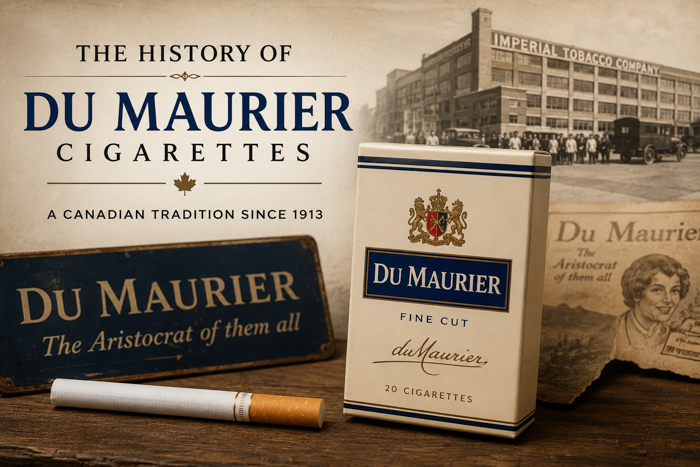
Some of the most enduring brand names in history started with a favor between friends rather than a marketing meeting. Du Maurier cigarettes are a perfect example. What began in the late 1920s as a personal endorsement to help a cash-strapped actor cover his tax bill grew into one of the most recognized cigarette brands in the world — a brand that would go on to shape Canadian arts funding, produce a genuine LPGA golf major, and become entangled in some of the most consequential tobacco litigation and regulation in North American history. This is the long story of how a favor to a stage actor turned into nearly a century of commercial, cultural, and legal history spanning Britain, Canada, and the Caribbean.
A Favor for a Famous Actor
The story starts with Sir Gerald du Maurier, one of the leading British stage actors of his era and a man celebrated for his understated, naturalistic style of performance — a real departure from the theatrical bombast common in the early 20th century. Du Maurier was known for treating even romantic or intense scenes with a kind of nonchalant cool, famously advising fellow actors to underplay emotion rather than overact it.
By the late 1920s, du Maurier had a problem that had nothing to do with the stage: years of neglecting his finances had left him facing serious pressure from British tax authorities. Around 1929, he agreed to lend his name and reputation to a new cigarette brand in exchange for royalty payments, a common enough arrangement at the time for celebrities looking to supplement their income. His easy, cigarette-in-hand persona on stage made him a natural fit for the endorsement, and the brand that carried his name quickly became associated with his effortless, sophisticated image.
It’s a detail worth clarifying, since it’s often mixed up: the brand was not named for the novelist Daphne du Maurier, author of Rebecca and Jamaica Inn. She was Gerald’s daughter, and while the family connection is real, the cigarette brand predates her literary fame and was built entirely around her father’s celebrity.
Launch in Britain
Du Maurier cigarettes debuted in the United Kingdom around 1929–1930, produced initially by Peter Jackson Ltd., a subsidiary of International Tobacco. The brand launched as a plain (non-filtered) cigarette sold in a distinctive blue pack, and it found an audience quickly, becoming one of the more successful cigarette lines in the British market during the early 1930s.
In 1934, ownership of the du Maurier trademark passed to Gallaher, a major British tobacco company that would go on to shape the brand’s identity for decades. Two years later, in 1936, Gallaher introduced a filter-tipped version of du Maurier in the UK — notable at the time as one of the first cigarettes with a filter to be produced on a genuinely commercial scale. This filtered version was marketed heavily toward women, part of a broader industry shift in the 1930s toward positioning cigarettes as a symbol of modern, independent femininity.
Sir Gerald himself took an active role in promoting the brand, participating in advertising campaigns and promotional tours across Britain. It turned out to be one of the more effective celebrity endorsements of the era, cementing an association between the actor’s relaxed charisma and the cigarette that carried his name.
Crossing the Atlantic to Canada
Du Maurier’s most lasting home turned out to be Canada. The brand arrived there in 1936, manufactured under license by the Tuckett Tobacco Company, itself a subsidiary of Imperial Tobacco Canada. From the outset, du Maurier was pitched as a premium product, and it steadily built a loyal following in the Canadian market over the following decades.
Ownership of the international trademark shifted again in 1955, when British American Tobacco (BAT) acquired rights to the du Maurier name across most of the world after prolonged negotiations. This set the stage for BAT’s Canadian subsidiary, Imperial Tobacco Canada, to take over full production of the brand in 1966, a role it would hold for the next thirty years.
The Canadian du Maurier line expanded over time to fit changing consumer tastes. A king-size version arrived in 1962, well ahead of the transition to Imperial Tobacco’s full ownership. In the years that followed, the lineup grew to include variations such as Special Mild, Light (later called Distinct), and Extra Light (Prestige) formulations, along with a 100mm size introduced in the early 2000s. For a period in the mid-2000s, the brand also experimented with charcoal-filter variants aimed at competing with rival products from other Canadian tobacco companies, though these were discontinued by 2011.
Becoming Canada’s Premium Brand
By the 1970s and 1980s, du Maurier had settled into a position that few cigarette brands ever achieve: it wasn’t just popular, it was aspirational. Within the Canadian market, du Maurier was consistently positioned and perceived as the premium option, priced and packaged to sit a notch above mass-market competitors. Its red-and-gold color scheme and clean typography became instantly recognizable on convenience store shelves across the country, and for a long stretch it held the title of best-selling cigarette brand in Canada.
That premium reputation didn’t happen by accident. Imperial Tobacco Canada leaned heavily into associating the du Maurier name with sophistication, culture, and success — an extension of the same strategy that had worked so well for Sir Gerald du Maurier decades earlier in Britain. Rather than chasing volume through discount pricing, the company built a brand identity around exclusivity, taste, and a certain kind of understated Canadian elegance. That strategy found its fullest expression not in traditional advertising, but in one of the most extensive corporate arts and sports sponsorship programs Canada has ever seen.
The Du Maurier Arts Council: Canada’s Biggest Private Arts Patron
Starting in 1981, Imperial Tobacco Canada channeled a significant share of its du Maurier marketing budget into the arts, formally organizing its efforts under an entity called du Maurier Arts Ltd. (known in French as Les Arts du Maurier Ltée). Over the following two decades, this program became one of the single largest sources of private arts funding in the country. Between 1981 and 2003, du Maurier Arts Ltd. distributed more than $60 million to roughly 675 arts organizations across Canada, touching everything from small regional festivals to some of the country’s most prominent cultural institutions.
The list of beneficiaries reads like a survey of Canadian high culture: the Canadian Opera Company, the Opéra du Québec, the Calgary Opera, the Shaw Festival, and major symphony orchestras in Toronto, Montreal, Vancouver, and Winnipeg all received du Maurier funding at various points. The company also helped bankroll physical infrastructure for the arts — most notably contributing to the conversion of a former ice house on Toronto’s waterfront into what became the 400-seat du Maurier Theatre Centre, a performance venue used for both musical and theatrical productions on the city’s Harbourfront.
Du Maurier also used its arts funding to discover and champion emerging Canadian talent. From 1977 to 1984, the company sponsored an annual competition for young performers, first called the du Maurier Search for Talent and later renamed the du Maurier Search for Stars. Among the winners over the years were musicians who would go on to notable careers, including cellist Desmond Hoebig, violinist Gwen Hoebig, and singer-songwriter Loreena McKennitt, who would later become one of Canada’s best-known recording artists.
Perhaps the most visible piece of du Maurier’s arts sponsorship, though, was jazz. Starting in 1985, the du Maurier Arts Council became the title sponsor of an international jazz festival in Toronto, and by the early 1990s had extended similar sponsorships to jazz festivals in Vancouver, Edmonton (branded Jazz City), and Saskatoon, as well as supporting festivals in Winnipeg, Montreal, and Halifax. At its peak, the company’s jazz sponsorships alone reached roughly $6 million annually, and du Maurier’s overall arts, culture, and sports sponsorship across Canada totaled an estimated $65 million during its heyday. In cities like Vancouver, the du Maurier name accounted for as much as 20 percent of an individual festival’s entire operating budget — a level of dependency that would later prove precarious.
Teeing Off: The Du Maurier Classic and Women’s Golf
Du Maurier’s sponsorship ambitions extended well beyond concert halls and jazz clubs and into professional sports, most significantly through golf. The tournament that would eventually become known as the du Maurier Classic actually began in 1973 under the name La Canadienne. From 1974 through 1983, it was rebranded as the Peter Jackson Classic, named for the same tobacco company lineage connected to du Maurier’s British origins. In 1979, the event was elevated to major championship status on the LPGA Tour, joining the U.S. Women’s Open and the LPGA Championship as one of the sport’s three most prestigious tournaments for several years running.
The tournament took on the du Maurier Classic name in the 1980s and went on to become one of the most storied fixtures in Canadian professional sports. It rotated among some of the country’s finest golf courses, including Beaconsfield Golf Club in Quebec, St. George’s Golf and Country Club and Essex Golf & Country Club in Ontario, and Vancouver Golf Club in British Columbia. Over its more than two decades as a major championship, the du Maurier Classic crowned a roster of golf’s biggest stars as champions, including Pat Bradley — who won the tournament three times, in 1980, 1985, and 1986 — along with Juli Inkster, Sally Little, Nancy Lopez, Brandie Burton, and future Hall of Famer Annika Sörenstam, who finished runner-up in 1998.
Du Maurier’s sports sponsorship wasn’t limited to golf. The brand also served as title sponsor of the women’s event at the Canadian Open tennis championships from 1997 until 2000, extending its association with elite women’s professional sport across two major disciplines simultaneously.
The Regulatory Tide Turns
Through the 1970s and 1980s, tobacco marketing in Canada operated with relatively few restrictions, which is exactly what allowed strategies like the du Maurier Arts Council and the du Maurier Classic to flourish in the first place. That environment began to shift decisively in the 1990s, as growing public health awareness and mounting scientific consensus about the dangers of smoking pushed Canadian lawmakers toward much tighter controls on how tobacco companies could advertise and promote their products.
The first major blow came with federal tobacco sponsorship regulations introduced in 1996, which began restricting how prominently companies like Imperial Tobacco could feature the du Maurier name at sponsored events. Then came Bill C-71, the Tobacco Act, which phased in even stricter limits and set a hard deadline: full restrictions on tobacco sponsorship of arts, culture, and sporting events would take effect in October 2003, effectively banning the practice altogether.
The years leading up to that deadline played out as a slow-motion withdrawal. Du Maurier’s marketing team announced in the late 1990s that the company would not return as title sponsor of Toronto’s jazz festival beyond a certain point, leaving organizers scrambling to replace a contribution that had once reached $1 million annually. Even as the ban approached, du Maurier maintained some of its commitments longer than expected — continuing, for instance, as the main sponsor of the Vancouver International Jazz Festival even after Bill C-71 passed, still covering roughly 20 percent of that festival’s budget as late as 2000. But the writing was on the wall. Du Maurier’s national marketing manager acknowledged publicly that the new regulations made title sponsorship “unworkable” going forward, and by 2001 du Maurier’s advertising for its remaining sponsored events was already confined to publications legally classified as adult-only content.
By October 2003, the deadline arrived and the du Maurier Arts Council was formally disbanded. In its place, Imperial Tobacco Canada created two replacement programs — the Imperial Tobacco Canada Arts Council and the Imperial Tobacco Canada Arts Fund — that continued making charitable donations to arts organizations, but at a fraction of the previous scale (roughly $3 million annually, compared to the tens of millions distributed at the height of the du Maurier-branded era) and without the direct brand-name sponsorship that had defined the earlier program. Canadian arts organizations that had built entire festivals around the du Maurier name, from jazz festivals in half a dozen cities to a French-language baroque music festival in New Brunswick receiving a few thousand dollars a year, were forced to find new funding sources almost overnight. Many jazz festivals eventually found replacement sponsors in the financial sector, a shift in Canadian arts patronage that persisted for the following two decades.
Golf faced the same reckoning. The du Maurier Classic played its final edition as an LPGA major in 2000, after which new tobacco sponsorship legislation made it impossible for the tournament to continue under that name and structure. The event survived, however, evolving into what is known today as the Canadian Pacific Women’s Open (formerly the Canadian Women’s Open), while the LPGA elevated the Women’s British Open to major championship status starting in 2001 to fill the gap left in its tournament calendar. It’s a small irony of golf history that one of the sport’s four modern women’s majors exists in its current position largely because a Canadian cigarette brand was legally barred from continuing to sponsor its predecessor.
Corporate Consolidation and the End of Canadian Manufacturing
While marketing restrictions were reshaping how the public encountered the du Maurier name, the corporate structure behind the brand was also shifting. Imperial Brands Ltd. took over production responsibilities in Canada in 1996, continuing under the broader ownership of British American Tobacco. Then, in 2008, Imperial Tobacco Canada made the significant decision to cease its domestic manufacturing operations entirely. From that point forward, du Maurier cigarettes sold in Canada have been produced at BAT facilities outside the country, even though the brand has retained its distinctly Canadian identity and, for years afterward, remained the top-selling cigarette brand in the Canadian market.
Du Maurier’s fortunes elsewhere told a very different story. In the United Kingdom, where the brand had originated, it eventually vanished from store shelves altogether as smoking rates declined for good and British tobacco regulation tightened well beyond what Canada had implemented. Today the du Maurier name means little to most UK consumers, a striking reversal for a brand that began as a quintessentially British celebrity endorsement. The brand did find one smaller but genuinely persistent home outside Canada: Trinidad and Tobago, where it has continued to be produced under license by the West Indian Tobacco Company for the Caribbean market, largely outside the spotlight that has followed the brand in North America.
Litigation and the Cost of a Century in Tobacco
No history of a major North American cigarette brand would be complete without acknowledging the legal reckoning that eventually caught up with the entire industry, and Imperial Tobacco Canada — du Maurier’s manufacturer for most of its Canadian history — was no exception. Canadian tobacco companies, including Imperial Tobacco, faced a wave of lawsuits over the years addressing issues ranging from misleading “light” and “mild” cigarette labeling (marketing terms that implied reduced health risk despite little pharmacological difference in how such cigarettes were actually smoked) to allegations that internal industry research on smoking’s dangers had been suppressed or destroyed rather than disclosed.
These legal pressures culminated in landmark outcomes: a multibillion-dollar class action settlement covering Canada’s major tobacco manufacturers, and separate litigation specifically targeting “light” cigarette marketing that resulted in enormous damages awards and record-setting legal fees. Imperial Tobacco Canada and its parent, British American Tobacco, were also swept into government investigations and lawsuits over cigarette smuggling across the Canada–U.S. border during the 1990s, a scheme that tobacco companies were later found to have been complicit in, and for which Imperial Tobacco and other Canadian manufacturers eventually paid hundreds of millions of dollars in penalties and settlements. These episodes, while not unique to du Maurier as a specific brand, form an inseparable part of the broader corporate history behind the cigarettes sold under its name.
Packaging in the Age of Plain Packaging
As advertising and sponsorship avenues closed off one by one, packaging itself became one of the last remaining tools available for cigarette brands to differentiate themselves on Canadian store shelves — and even that tool has steadily been taken away. Mandatory graphic health warnings, first introduced on Canadian cigarette packages in the 1990s and expanded significantly in the 2000s, meant that a growing share of every du Maurier pack’s surface area was legally required to display images and text warning of smoking’s health effects, long before “plain packaging” laws existed anywhere in the world.
The 2005–2006 period brought one of du Maurier’s more significant packaging redesigns, introducing new “signature pack” flip-top boxes for king-size cigarettes along with matching carton designs holding eight packs. It would prove to be one of the last major branded packaging refreshes the company was able to pursue with real design freedom. Canada went on to become one of the first countries in the world to mandate standardized plain packaging for all tobacco products, stripping brand logos, distinctive color schemes, and custom typography down to a mandated uniform design, with the brand name reduced to small, standardized text against a plain background dominated by health warnings. For a brand that had spent nearly a century cultivating a specific visual identity — the blue pack of 1929 London, the red-and-gold Canadian livery of the postwar decades, the sleek signature packs of the 2000s — plain packaging represented perhaps the single greatest transformation in how consumers encounter the product at retail.
Canada’s Regulatory Firsts, and What They Meant for the Pack
Du Maurier’s decline as a marketing powerhouse didn’t happen in a vacuum — it tracked almost exactly alongside Canada’s emergence as one of the world’s most aggressive regulators of tobacco packaging, and the du Maurier brand ended up serving as a kind of live case study for nearly every milestone along the way.
Warnings on Canadian cigarette packs actually date back further than many people realize, with basic printed warnings appearing as early as 1972. But the regulatory floodgates really opened in the late 1980s with the Tobacco Products Control Act, which pushed Canada toward far starker, harder-to-ignore warning text and began chipping away at the freedom manufacturers like Imperial Tobacco had long enjoyed to design eye-catching packaging. By 1989, printed health warnings were mandatory on all tobacco packages sold in the country.
The next major leap came in 2000 and 2001, when Canada became the first country in the world to require graphic, picture-based health warnings directly on cigarette packaging — a policy so novel at the time that it triggered international attention and was eventually adopted by more than 115 other countries and jurisdictions. For du Maurier, this meant that its carefully cultivated red-and-gold packaging now had to share space with graphic medical imagery, a jarring juxtaposition for a brand that had spent seventy years building an image of clean, premium sophistication. Regulations tightened further in 2012, when Canada mandated that graphic warnings cover a full 75 percent of a pack’s front and back surfaces and include a quitline phone number for smokers looking to quit.
Then, in 2019, came the change that arguably did more to erase du Maurier’s visual identity than any single event in its history: Canada’s national plain packaging regulations. Under these rules, all cigarette packages sold in the country — regardless of brand — were required to adopt a single standardized shape, size, and drab uniform color, with brand names reduced to small, plain typeface and virtually all other stylistic elements, including logos and distinctive color schemes, prohibited outright. The blue pack from 1929 London, the red-and-gold Canadian branding of the postwar decades, the sleek “signature pack” flip-top box introduced in 2005 — all of it gave way to a legally mandated design nearly indistinguishable from that of every competing brand on the shelf.
Canada pushed the concept even further in the 2020s. In 2023 and 2024, the country became the first in the world to require health warnings printed directly onto individual cigarettes themselves, not just their packaging — meaning a du Maurier cigarette pulled from its pack today may carry printed messages like “poison in every puff” running along the paper itself, in both English and French, phased in for king-size cigarettes first and extended to regular-size formats shortly after. It’s a remarkable bookend to the brand’s history: a product launched in 1929 explicitly to be “less irritating,” marketed for generations through glossy advertising, prestige arts sponsorships, and championship golf, now sold in a country where the cigarette itself is required by law to carry a warning about the harm it causes.
The Product Lineup: How Du Maurier Evolved on the Shelf
Behind all the sponsorship deals and regulatory battles, du Maurier was, of course, still a physical product that had to keep pace with shifting consumer habits. The original 1929 UK cigarette was a plain, unfiltered smoke sold in regular length. The 1936 filter-tipped version marked the brand’s first major technical leap, arriving at a moment when filters were still a novelty rather than an industry standard, and helped position du Maurier as a more “refined” option relative to competitors still selling unfiltered cigarettes.
In Canada, the brand’s core offering for most of the twentieth century came in two lengths: a regular 75mm size and, starting in 1962, an 84mm king size that gradually became the dominant format as consumer preferences shifted toward longer cigarettes through the 1960s and 1970s. As health-conscious marketing gained traction industry-wide from the 1970s onward, du Maurier broadened its lineup to include reduced tar and nicotine variants — Special Mild, later formulations branded Distinct (positioned as a “light” option) and Prestige (marketed as “extra light”) — alongside the traditional full-strength Regular and Signature lines. A 100mm “super king” length was added to several of these variants in the early 2000s, matching a broader industry trend toward longer, slimmer cigarette formats aimed particularly at female smokers.
The mid-2000s brought one of du Maurier’s more short-lived product experiments: charcoal-filter versions sold in distinctive white packaging, designed specifically to compete with a rival Canadian brand’s charcoal-filter offering. Charcoal filters were marketed on the promise of a smoother smoke, though the scientific evidence for any meaningful reduction in harm was thin at best. These variants lasted only a few years before being discontinued in 2011, a relatively quiet retirement compared to the fanfare that had once accompanied new du Maurier product launches.
By the 2010s, du Maurier’s Canadian lineup had settled into a family of variants distinguished mainly by tar and nicotine strength and by pack color coding — a red pack for the flagship Signature blend, along with lighter-strength options in progressively paler color schemes — a visual shorthand that plain packaging laws would later render largely obsolete once uniform packaging replaced brand-specific color coding across the entire Canadian tobacco market. Long-time smokers of the brand often navigated the lineup by color and pack shape as much as by name, a habit built over decades that plain packaging effectively dismantled overnight when every brand on the shelf was forced into the same drab presentation.
Setting the Record Straight: Gerald, Not Daphne
It’s worth returning, one more time, to a point of confusion that follows the du Maurier brand almost everywhere it’s discussed online: the persistent misconception that the cigarettes were named after novelist Daphne du Maurier. It’s an understandable mix-up. Daphne du Maurier is by far the more internationally famous member of the family today, thanks to novels like Rebecca and Jamaica Inn and the Alfred Hitchcock films they inspired, while her father Gerald’s reputation as a stage actor has faded considerably outside theater history circles. Some retellings of the du Maurier cigarette story lean into this confusion, even suggesting a literary or romantic mystique to the brand that has nothing to do with its actual origins.
The historical record is clear on this point: the cigarettes were named for and promoted by Sir Gerald du Maurier himself, initially as a solution to his tax troubles rather than any deliberate branding strategy tied to the family’s literary legacy. Daphne was a teenager when the brand launched in the late 1920s, years before she published her first novel. Any connection between the cigarette brand and literary sophistication is really an accident of shared surname and, perhaps, a shared family talent for capturing the public imagination — Gerald through his stagecraft, Daphne through her prose — rather than any intentional link the brand itself was built around.
A Name That Outlasted the Man
Nearly a century after Sir Gerald du Maurier lent his name to settle a tax bill, the brand that bears it has passed through the hands of at least four different corporate owners — Peter Jackson Ltd., Gallaher, Imperial Tobacco Canada, and ultimately British American Tobacco — crossed continents, funded hundreds of arts organizations, backed a genuine major golf championship, weathered a landmark class-action legal reckoning, and adapted to some of the strictest tobacco packaging laws in the world. Few consumer brands can claim a history that touches jazz festivals in half a dozen Canadian cities, a professional golf major won by some of the sport’s greatest champions, a Toronto theatre still in use today, and a courtroom record spanning smuggling investigations and product-labeling lawsuits.
Du Maurier’s staying power says less about any one product formulation and more about the durability of a brand identity established in its earliest years — an image of understated, confident sophistication borrowed from a stage actor who, as it happens, never intended to become quite so permanently associated with smoking, and who could hardly have imagined that his name would eventually be attached to a Canadian arts council, an LPGA major, and a plain, standardized cigarette pack nearly a century later. It’s a reminder that brand histories, especially the long-lived ones, rarely stay confined to the product itself — they end up woven into the cultural, legal, and regulatory fabric of the countries where they took root.
Few brand stories offer such a clean illustration of how commercial fortune, cultural patronage, and public health policy can become permanently intertwined. A single trademark, born from one actor’s tax problems, ended up funding symphony orchestras, launching the recording career of a future star, crowning champions on some of the world’s best-known golf courses, and eventually becoming a test case for some of the most sweeping tobacco packaging laws ever written. Whatever one makes of the underlying product, it’s hard to find many consumer brands whose century-long arc says quite so much about the countries — and the eras — they passed through along the way. Du Maurier’s story isn’t really about cigarettes at all, in the end; it’s about how thoroughly a single trademark can become entangled with the culture, sport, and law of the places it calls home, long after the man whose name it bears has been mostly forgotten by everyone but historians of the London stage.